By 1891 the former Plumber’s Arms had become No. 29 Princes Street, occupied by Rebecca Levine, a widow, and her son Reuben, an antiques dealer and daughters Minnie and Amelia.
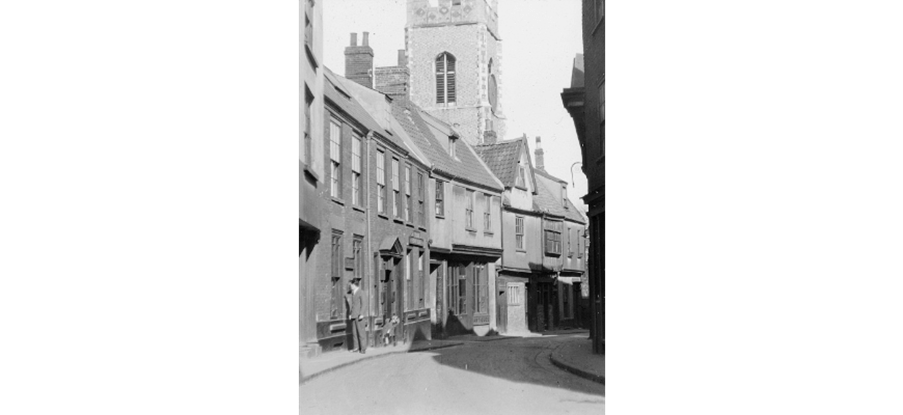
Lantern slide reference number: 7182. Norfolk County Council. “Antiques” sign can be seen under the window of 20.
Rebecca Levine was born Rebecca Reeve, somewhere between 1833 and 1837, in Norwich. There are no church records of her baptism or birth date, presumably because she was from a Jewish family and therefore not baptised. She married Moses Levine some time before 1866 – again, no records remain of this.
Moses was born in 1834 in Mitau, Courland, part of the Russian Empire and now in present day Latvia. Moses first appears in Norwich records in 1859, as living in St Gregory as an occupier. It seems likely that it was he and his brother Joseph who were made bankrupt in 1859 as “Joseph Hervitch Levine and Moses Hervitch Levine”, tobacconists.
His bankruptcy was the first of several appearances in court for Moses, and it seems he did not take it well.
Levine was charged by Engelbert Nowack, better known in the city as ” Dr. Hugo,” with using abusive and threatening language towards him. It appeared that the defendant had been under the unfortunate necessity of taking the benefit of the Insolvent Act, and his examination took place on the previous day at the County-court. The complainant had been summoned to give evidence the case, and whilst doing so made certain statements which defendant considered reflected not only on his character, but on that of a female friend. On leaving the court, the complainant and defendant encountered each other, and the latter, it was alleged, called the former a scoundrel, thief, and other epithets of similar character, and threatened to ” have his soul out.” This he repeated at subsequent period of the day, and the complainant, who affirmed that he conducted himself in a perfectly quiet manner under the circumstances, obtained a summons against him. The defendant denied using the language complained of, but admitted having threatened to summon complainant for his aspersions on the character of innocent female ; and his statement was in fact corroborated by a witness, who, however, admitted that defendant had called complainant a scoundrel. Under these circumstances the magistrates bound both the parties over £10 to keep the peace for six months.[1]
In the 1861 census Moses was recorded as a traveller, lodging in Betts Yard in St Lawrence with Henry Rubenstein, a shoemaker. In early 1863 he was in court again, this time as the plaintiff, after having had jewellery stolen from him. In October 1863 he was made bankrupt for a second time. [2]
Moses was living with Rebecca in St Gregory’s Alley in 1871 with their children Reuben aged 5 and Minnie aged 2. Moses’ occupation is given as “jeweller”. His older brother Joseph Levine (1830-1914), a tailor, was living a few doors down in the same alley with his family – wife Hannah and children Reuben, Robert, Louis and Rebecca. Joseph had married Hannah, nee Bandon in 1859 at the synagogue in St Faith’s Lane.
Moses was also lending money and investing in property, which led to several further appearances in the courts and in the newspapers, trying to recover debts and rent. He was in court in 1872, claiming that a chimney sweep, by the name of George Lincoln, should be committed to prison under the Debtor’s Act for failing to pay back the instalments on a loan Moses had made to him. In February 1876 Moses was back in court again, trying to recover the rent of a cellar from John Brett, a cabinet maker. In August 1876 he summoned Henry Hardyment, a scavenger, for feloniously stealing a waggon load of horse manure, belonging to Moses. The case was dismissed.
By 1881 Moses had moved to Pottergate Street, with his family – Rebecca, Reuben, Minnie and Amelia – where he was running a jewellery shop.
He died in 1886, at the age of 53, in a boating accident along with two others. The coroner was of the view that the case “presented in no features bordering in any way on criminal neglect” and the jury concurred. The boat was a private steam launch owned by Moses which was carrying seven people on board on a trip from Thorpe Station to Whitlingham. The launch collided with the Jenny Lind, a passenger steamer and capsized. [3]
Moses Levine’s will of October 1886 described him as of St Georges Bridge St, jeweller, tobacconist and shoe manufacturer. He left £897 13s 11d (£150,000 in today’s money). Rebecca presumably moved to Princes Street shortly after this, with their son Reuben. Moses had amassed 23 freehold properties in Norwich by the time of his death, according to a notice of their auction in 1888.
Reuben did not follow his father into the jewellery or tobacco business, although perhaps he was able to use the money raised from his father’s properties to seed his own enterprise. According to the 1892 directory, he was a furniture broker and dealer, at 29 Princes Street. In the same year Reuben married Ellen Elizabeth Nolloth at Holy Trinity Church in Great Yarmouth. They initially lived in Princes Street, as their first child, Agnes Amelia, was baptised in St George Tombland. They continued to baptise their children but kept a small clue of Reuben’s Jewish heritage in the choice of their children’s names.
Their second child, Catherine Esther, was also baptised, at St Martin at Palace in 1895, with the address given as 19 Prince of Wales Road. Their third child Alfred Nolloth was baptised at St Andrew in November 1897, although their parish of abode was St George Tombland.
Rebecca died in December 1897 in Great Yarmouth, aged 67. Her son Reuben had continued to live in Norwich, as evidenced by the fact that his fourth child, William Benjamin, was born in 1898, baptised at St Andrews, again with the parish of abode being St George Tombland. William Benjamin died less than a year later and was buried at the Rosary Cemetery. The Levines were still living in St George Tombland in 1901, according to the baptism records for their twins, George Jacob and Olga Edith Mary, who were born in June 1900 and baptised in March 1901 at St Andrews.
They must have moved very shortly after the baptism of the twins, as the 31 March 1901 census records them as living at number 312 Unthank Road. Reuben was recorded as a dealer in works of art, living with his wife, 5 children and a servant.
It was not long, however, before they moved from Unthank Road to 147 Newmarket Road, as shown on the baptism records at St Andrews for their daughter Miriam Nolloth, who was born in 1902. Their eighth and final child, Walter Michael, was born in September 1904, and also baptised at St Andrews a month later. Their eldest child, Agnes Amelia, died in 1906, at Newmarket Road, at the age of 13.
They must have moved back to Unthank Road a few years later, as Reuben and Ellen’s oldest son Alfred Nolloth died at 393 Unthank Road the age of 23 in 1920, and the 1921 census also shows the rest of the Levine family living at that address. It seems Alfred may have been ill for some time, as there is no record of him serving in WWI, whereas his younger brother was in the Royal Navy Volunteer Reserve Service and served on the HMS Victory VI in 1918.
By 1921 George Jacob was working for his father as an art dealer’s assistant, living with his parents and his sisters Catherine and Olga who were occupied with “home duties” and his siblings Miriam and Walter who were 19 and 16 respectively.
Reuben died in in Norwich in 1927, by then living at 50 Prince of Wales Road, leaving £24,509 (£2m in today’s money). George Jacob Levine continued the family business as an art dealer, living in Blofield. He married Doris Pritchard, in 1934, when she was 32 and he was 34. They had at least one child, Jennifer, born in 1935. George, Doris and presumably Jennifer (but redacted from the records) were registered in 1939 as living at The Gables, in Blofield and Flegg. George died in 1979 aged 79 and Doris in 1987 at the age of 85. They were buried together in St Michael’s and All Angels Churchyard, in Braydeston, Brundall, Norfolk.
[1] Norfolk Chronicle, 20 July 1859 p 3
[2] Norfolk Chronicle, 24 October 1863, p 7
[3] Eastern Evening News, 31 August 1886 p 3
 Friends of Princes Street