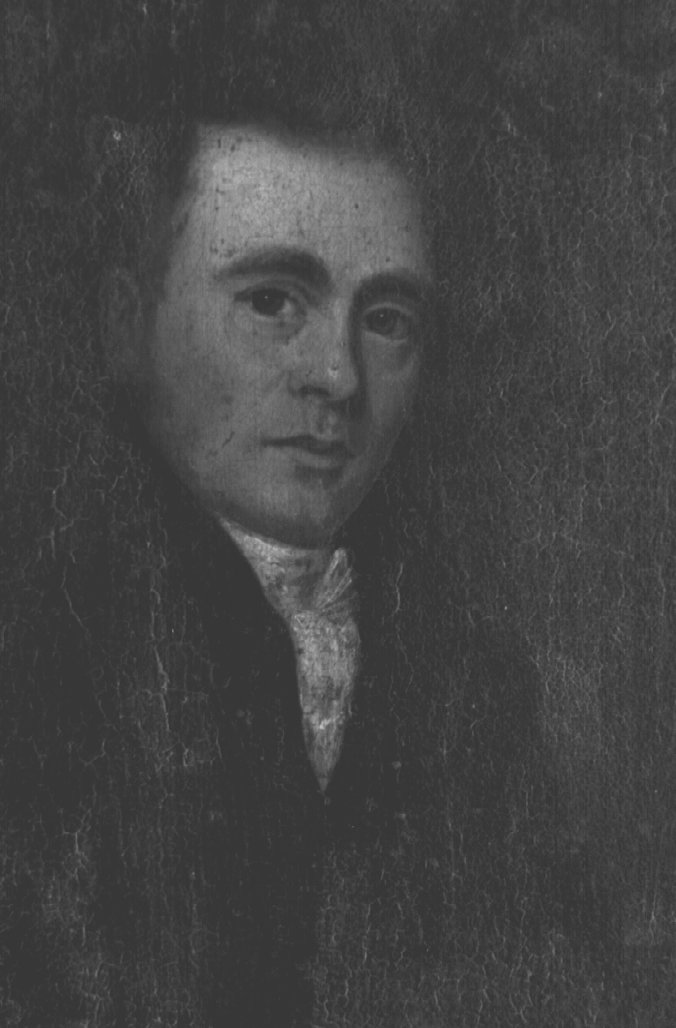
John Darke/in (1785-1863) and John Ninham (1775-1841) had much in common – descended from Protestant refugee families, involved in the building trade, connected to the arts of music and painting, and at one point sharing premises on Princes Street. They both became bankrupt in 1837 and the Darkens also had various sexual “black sheep” in the family.
The portrait above, of John Darken may well have been painted by John Ninham himself, or his artist brother Henry, or John’s son John Michael Ninham.
The Darkens in Norwich and America
John Darken (sometimes Darkin) was the youngest son of William Darken (1749-1824) and Sarah, nee Chandflower (1749-1831). The Darken line traces back to the late 17th century – when a Robert Darkins was in Woodbridge, in Suffolk, and the name may have been an Anglicisation of D’Archennes – another indication of possible roots in the French and Dutch speaking protestants who fled persecution. Chandflower was probably the Anglicisation of a French name, Champfleur – showing similar ancestry.
Sarah Chandflower was baptised at the non-conformist Old Meeting House on Colegate. William Darken and Sarah married there in 1771 had their second son Samuel baptised there in 1779. Their other children were baptised at St Clement’s, St Julians’ and St Gregory’s churches however.
Darken married Frances Daynes in 1808 at St Gregory’s church. He had a building company in the 1820s, frequently advertising in the Norwich Mercury new stocks of timber, or houses that he had presumably built, along with his father in law, John Daynes or Deyns in Norwich and North Walsham, for sale or to let.
John Darken and Frances initially lived in the parish of St Gregory, and then St Julian, and then St Michael at Plea, but had their five sons – Edward John, John Joseph, Thomas William, Horace and William Henry – all baptised at the Particular Baptist St Margaret’s Chapel, which was on what is now Three Kings’ Lane, off Pottergate.
In 1830 Darken dissolved his interest in a foundry business which had gone into bankuptcy in St Martin’s at Palace and then took his family to the United States. James Worman and Simon Stout of Princes Street announced that they took his business over.
The Darkens were intending to become inhabitants of the United States according to the passenger list for the Salem. They were heading to upstate New York, but ended up in Pennsylvania where John was commissioned to build a church. This was most likely St. Stephen’s Episcopal Church in Wilkes-Barre which had outgrown its initial 1823 wood-frame building. He was apparently cheated by the building committee and the church collapsed during the spring rains. (From NeilASCarver on Ancestry.com) Darken returned to Britain after his wife Frances died in Pennsylvania and his mother Sarah died in Norwich, in 1831.
He placed a notice in the Norfolk Chronicle in September 1832 to contradict a malicious report that he voted at the election for Sheriff. “I did not vote at all yesterday, nor did I tender my vote, neither did I intend to do so, not having resided in my native city a sufficient time since my return to England, to entitle me to vote.”[1]
John Darken remarried in 1833 to Elizabeth Deynes, the older sister of his late wife. By 1834 he was advertising his business on Princes Street, offering the construction of horticultural buildings with heating by water. The same year, his older brother William was arrested and imprisoned for two years in Norwich Gaol, for assault with an unnatural intent – bestiality.
The Ninhams
John Ninham junior was a painter, plumber and glazier, who had occupied premises and may also have been living on Princes Street in St George Tombland since at least 1822. He was in a partnership with his son John Michael Ninham, an “imitative painter”.
John Ninham was the older brother of the Norwich School painter Henry Ninham (1796-1874). Their father was John Ninham (1753-1817), also a painter. The art historian William Dickes, writing in 1905, believed John and Henry Ninham’s grandfather was a French Huguenot who had fled religious persecution after the revocation of the Edict of Nantes, in 1685.1 The Ninham ancestry traces back to the late 17th century in Woodton, Norfolk, to Robert Ninham, their great great grandfather, who was probably born around 1670, but there is no record of his baptism in England, so it could be that he was born in France. It is difficult to work out what the French version of the surname Ninham might have been, however.

John was born in 1774, the oldest child of John Ninham senior and Elizabeth, nee Vine. He was baptised at St George Colegate. He married Ann Springall in 1799 at St Giles church in Norwich.
They seem to have moved to St Peter Hungate from St Giles by the 1810s by which time they had six children. In 1813, their seventh child, Caroline, was baptised in St Peter Hungate rather than St Giles as for the other six. She died a week later and was buried at St Giles, but her abode was recorded as St Peter Hungate. Unlike the Darkens, they did not seem to be upholding their Protestant non-conformist heritage in their choices of church.
The 1822 Pigot’s directory entry for John Ninham shows him as a painter, plumber and glazier on Princes Street. He may have moved from the St Peter Hungate end to the St George Tombland end of Princes Street, as when another of John and Ann’s daughters, Louisa, died in 1829 aged 19, “after a severe affliction”, she too was buried at St Giles, but her abode was given as St George Tombland.
John Ninham junior may well have bought a Princes Street property in June 1834, when there was an auction of “all that dwelling house with appurtenances and carpenter’s work rooms and convenient yard, opening into Princes-street, in the parish of St George Tombland, now in the occupation of Mr Darken, builder, and all that dwelling house adjoining the last lot, with appurtenances, pleasantly situated next Princes’ Street, now unoccupied. Late in the occupation of Mr William Allen, stone mason.”[2] If so, it seems Darken had continued to occupy the work rooms and Ninham had moved into the dwelling house.
John Ninham senior’s wife Ann died in April 1835 and was buried at St George Tombland. A notice was placed in the Norfolk Chronicle “in the 60th year of her age, after severe illness, which she bore with Christian fortitude and pious resignation to the will of her Divine maker, Ann, the beloved wife of Mr John Ninham, plumber and glazier, Tombland.”
Less than six months after his wife’s death, John Ninham, by then 60, married a Devonian woman, in Heavitree, Harriot Joslin, who was 35 years younger than him. A year later they had a son, William Henry Thomas Joslin Ninham, born in October 1836, who was baptised at St George Tombland.
Bankruptcies and radicalism
In 1836 the series of good harvests in Britain came to an end. The Bank of England, wanting to improve their reserves and cushion against American defaults, started to raise interest rates. A serious depression in business, trade and exports hit Britain, with a dramatic increase in unemployment, and railway construction coming to a halt. This clearly impacted the construction industry too.
The 1837 electoral roll shows that both John Darken and John Ninham were living on the St George Tombland end of Prince’s Street. It is likely this was on the south side of Princes Street, opposite 22-26.
In February 1837 John Ninham was declared bankrupt, with John Darken as one of the trustees. Ninham’s dwelling house, workshops and yards in St George Tombland were put up for auction in March. His painter, plumber and glazier partnership with his son John Michael Ninham was dissolved in April, with Ninham senior taking on all the debts.
Darken moved his premises from Princes Street to Magdalen Street in October 1837 and the Princes Street premises were taken over by another builder, A.T. Tillett. In December 1837 Darken was also declared bankrupt. In 1838 his residence in St Martin at Palace was put up for auction.
John and Harriet Ninham had a daughter, Harriet Joslin Ninham, in May 1838, who died a month after her birth, of consumption, at their house in Princes Street. Their second son Robert Ninham, who was born in December 1839, also died a month later. They were both were baptized at St George Tombland but Harriet was buried at the Rosary cemetery, the first non-denominational burial ground in the United Kingdom, and Robert was buried at St Giles church.
It seems from the above that Ninham and his family continued to live on Princes Street, perhaps as renters. His business entry in Pigot’s Directory of 1839 was as a painter on Princes Street.
John Ninham senior died on the 17th May 1841, at the age of 66, and was buried at St Giles, the parish of his birth, and where his son Robert was also buried. His death was reported by his oldest daughter Mary Ann, who had married Robert Mounsear, another resident of Princes Street, and an upholsterer and paper hanger.
Harriot announced in the Norwich Mercury that she intended to carry on the business, via John Green, the foreman to her husband. She was living in Princes Street, occupation “plumber”, with her son William and Sarah Joslin, possibly her mother or sister, at the time of the 1841 census.
She appeared in the 1845 in White’s History, Gazetteer and Directory under her own name, at Princes Street, in the list of plumbers, glaziers and painters. In 1850, she put the assets of the business up for sale, moved to London and remarried.
John Ninham’s son John Michael Ninham continued to live in Mousehold, Norwich, working as a land agent rather than a painter or glazier, with his second wife Martha and his daughters by his first marriage, until his death at the age of 71, in 1870. John Ninham’s younger brother, the painter Henry Ninham, lived until 1874.
John Darken re-started his building business and was in the 1839 Pigot Directory as Darkin & Son, on Magdalene Street. He sold his premises in 1844, and moved to Holt. His son John took on the building business and also became an auctioneer. Elizabeth, the “beloved wife” of John Darken, died in 1856 at the age of 72 and John died in 1863 at the age of 77. The obituary notice in the Suffolk Mercury described him as an architect and builder for many years in the City of Norwich.
The other person to carry on the Darken name was John Darken’s nephew, James Darken, who was living in St Gregory, Norwich. He carried on the family radical tradition as a bookseller, news vendor and secretary of the Norwich Radical Reform Association 1836-8. He was also the Norwich agent for The Operative – a journal “established by the working classes to defend the rights of labour from the aggressions of capital.” As publisher of another journal, the Searcher, he was fined £5 for publishing a libel, in 1840. The libel was a paid for notice by John Ollett Marshall, against Mr Sparkhall, a Norwich tea dealer. James Darken had three daughters and a son, James, who went on to become a pianoforte and music seller in Norwich.
Eugene Darken returns to Norwich from America
Fortunately John Darken was not alive to witness the flamboyant and catastrophic return of his grandson, Eugene.
John Darken’s eldest son, Edward John Darken, had stayed on in the United States, graduating from Yale, after which he became rector of a church in Connecticut. He was also politically active, as the Assistant Secretary to the Council of the House of Representatives, in Iowa in 1842.
Edward John Darken’s youngest son, Eugene, returned to Norwich in the 1860s. He married a Norwich born woman, Alice Cousins, the daughter of a shoe manufacturer, in 1868. He added “de Champfleur” to his name, in tribute to his great grandmother Sarah Chandflower, whom he claimed was descended from French nobility.
Initially he worked as a commercial traveller in the leather trade and then was a licensed victualler and shopkeeper on West Pottergate Street, living on Calvert Street in St George Colegate. He was bankrupted in 1872 and then became a piano tuner and singer, occupations which involved travelling a great deal – of his and Alice’s fourteen children, including three pairs of twins, six of whom lived to maturity, one was born in Hereford, one in Dublin, two in Suffolk and two in Dorset.
In 1887, Eugene Darken, then aged 43, was imprisoned for six months for indecently assaulting a twelve year old girl, Lily Gedge.
The account of the trial was as follows:
SERIOUS CHARGE AGAINST A NORWICH MAN. Eugene Darken, of 14. Unthank’s Road, Norwich, pianoforte tunist, was, on remand, charged by Superintendent Woolnough with indecently assaulting Lily Gedge, aged 12 years, at Dilham, on July 28th. Lily said she resided at Meeting Hill, Worstead, with her grandmother, and that she was 12 years of age her last birthday, on Thursday, July 28th. Between 11 and 12 at noon, as she was returning from Smallburgh on the Dilham Road, and coming In the direction of Worstead, she saw a man walking behind her a short distance. He soon overtook her, and asked the way to Honing. He walked beside her a short distance. and then said, “Come here, my little maid. You look hot and tired. Come and sit down a little while, and we will both start off together.” She replied,”No, I must make haste home. I have a bottle of medicine for grandmother.” He took hold of her arm and pulled her through gate into a wheat field. She began to cry. He pulled her down, and pulled up her clothes, and put his hand in her pocket, and said if she did not hold her noise he would cut her throat. He put his hand on her throat, and with his other tried to undo her under garments, and whilst doing so, suddenly stopped and listened, picked up his big, and ran away through the wheat field. The prisoner was the man. When she got up she saw two lads standing beside the gate on the road.
Two other witnesses confirmed that they had seen Eugene Darken in the area, with Lily, including a labourer who worked for William Deyns in Dilham. When the Worstead police sergeant received information of what had happened, and searched the area and then went to Eugene Darken’s house on Unthank Road the following Monday. Darken confirmed he was at Worstead on Thursday July 28th, after which he was arrested and taken to North Walsham Police Station for a line up, where the complainant at once identified him.
Darken said “It is a bad job for me. I had been drinking heavily the day before. I was half-mad and did not know what I had done.” He also said to the girl, “Did I hurt you when I put my hand over your throat?” He said nothing otherwise in answer to the charge. He pleaded guilty at the trial two months later and was sentenced to six months hard labour. The judge noted that “the prisoner used threats of violence if the girl did not consent to his wishes, and the offence was very serious one. He was rather surprised that the prisoner should have been in prison ten weeks, seeing that the inference was that not one of his friends had sufficient faith him to become bail for him. The girl had behaved with great propriety.”
A disclaimer was published in the local papers by James Darken, owner of a music warehouse in Queen Street, that Eugene was not his son, nor was he employed by James Darken or his sons as a piano tuner. Actually James Darken (1829-1889) was the son of James Darken the radical reformer and newsagent we met earlier. He and Eugene Darken were therefore second cousins – they had William Darken and Sarah Chandflower, in common as a great grandparents.
It does seem Eugene Darken was quickly recognised, and the fact that he was walking along the Dilham Road, very close to where his cousin once removed, an 60 year old unmarried farmer, William Deynes, was living, was surely not coincidental. The labourer who was a witness, was walking towards Eugene and Lily, carting manure back to William Deynes, his employer.
Eugene returned to his house on Unthank Road and was living there at the time of the 1891 census and in 1897 was on stage again as a singer, T. Eugene Darken.
By 1901 the family were living on Pottergate again, and Eugene’s occupation was recorded as pianoforte tuner and repairer and his given name as Thomas. In 1911 Thomas E. and Alice Darken were living in North Walsham with their daughter Fannie, a school teacher, and a boarder. They then moved to Great Yarmouth by 1921. Eugene died in 1922 at the age of 79. Alice lived further 10 years, dying in Cardiff at the age of 85, a much feared visitor to her daughters and daughters-in-law, for her insistence on being waited on and long habit of ordering from Fortnum and Masons.
Eugene and Alice’s son Eugene Edward de Champfleur Darken joined the cavalry, serving in Egypt in 1890 and then in India and South Africa. He moved to Australia with his wife in 1911, and lied about his age so he could enlist for the Great War, serving at Gallipoli, where he was wounded in the head. He died in Australia in 1938 at the age of 65.
[1] Norfolk Chronicle, 1 September 1832 p 2
[2] Norwich Mercury, 28th June 1834 p 1
https://archive.org/details/norwichschoolofp00dick/page/558/mode/2up


Leave a Reply