Robert Cremer (1799-1894) owned 26 Princes Street since the 1850s but did not move into the house until 1887. He was 89 years old and had only recently retired as one of Norwich’s first apothecaries.
Robert Rolfe Cremer was born in 1799 in Gimingham, North Norfolk, the fourth son, and one of the eleven children of John Cremer, a gentleman farmer who had been in the Norfolk militia, and Harriot Smyth. John Cremer was one of a long line of gentry in North Norfolk, dating back to Henry Cremer, who was born in Elmham in 1500. Robert Rolfe Cremer’s uncle, the Reverend Robert Rolfe, was a first cousin of Admiral Horatio Nelson.
Robert’s oldest brother joined the army, becoming a captain in the Royal Artillery. It seems that his second oldest brother, John Mott, went into the law but was in some way incapacitated by his fifties, as even though he did not die until his 60s, he became dependent on relatives and supported by friends, when he was living in Elm Hill, around the corner from Robert, in the 1850s and 1860s.
Robert’s third oldest brother, Philip, died at the age of 19 in 1816.
One of Norwich’s first licensed apothecaries
Given that his other brothers had pursued the usual routes for the sons of gentlemen of going into the army or law, Robert chose another route, medicine. At the age of 20, in 1819, Robert became a licentiate of the Society of Apothecaries. The Apothecaries Act of 1815 had given the Society the power to license and regulate medical practitioners throughout England and Wales – the beginning of the professionalisation of medicine in the UK.
In 1820, Robert Cremer’s father, John Cremer, died at the age of 65. It seems no one took over the farm as all his farming stock and household furniture was sold by auction over four days, even though Harriet his wife was still alive. She moved to Brighton, and died there in 1829.
A few years after qualifying, Robert Cremer married Phoebe Elizabeth Myers in St James, Paddington in London in 1822.
In 1830 Robert became the resident apothecary for the Norwich St Andrews Workhouse. He lived in Elm Hill, at the public dispensary there, not far from the workhouse which was behind St Andrew’s Halls on Bridge Street, where the Norwich University of the Arts now is.
Apothecaries in the public dispensary in Norwich were employed by the Court of Guardians, elected from Norwich citizens. By the mid 19th century apothecaries were provided with a salary of £100 per annum (around £12,600 in present purchasing power), with an allowance for coals and other essentials of £12. They were given an unfurnished apartment and were to visit the patients as often as the physicians may think proper, must not employ themselves in any private practice, nor absent themselves from the dispensary without leave from the Dispensary Committee of the Court of Guardians.
Cholera epidemics
Apothecaries and surgeons were awarded the occasional bonus on top of this. In 1833 the Court of Guardians awarded 30 guineas to Robert Cremer for his “extraordinary and persevering attention, saved a considerable sum of money to the rate payers, doing the work of two people and commended all the medical officers for the skill exerted with so much courage and humanity to mitigate the malignant effects” of a cholera epidemic the previous year.
In the 1840s Robert Cremer lived in Elm Hill with his wife Phoebe, a female servant and Robert’s nephew, 6 year old John Robert Cremer Plowright – who will reappear later in this story.
Phoebe died in 1843, at the age of 50. They did not have any children. It seems that shortly after her death Cremer married a local woman – Julia Knight – who was born in 1810 and baptised at St Peter Hungate on Princes Street.
Their first child was Julia, born in 1844, although it seems she was the only surviving twin from the notice in the Norfolk Chronicle. Then came Robert John in 1847 and Harriet in 1848, Ellen in 1850, Arthur James in 1851 and Laura Sophia in 1854. Ellen died in 1852, at only two years’ old, and was buried at St George’s Tombland church. Perhaps to accommodate a growing family, the Cremers moved from Elm Hill to St Andrew’s Street, or St Andrew’s Broad Street as it was then called.
With three children under five, Cremer then had to cope with another cholera epidemic which hit Norwich in 1848-9. No wonder that in 1850 one of the guardians reported that there had been complaints of the manner in which Cremer had dispensed medicines – “not incompetence or unwillingness, but simply from his having too much to attend to.” He was awarded a £10 gratuity (the equivalent of around £1,300 now) by the court of Guardians “in slight acknowledgement” of his services during that time.
Cremer’s “impropriety”
In 1853 Cremer was again the subject of discussion of the Court of Guardians. It appears Cremer went to a “respectable bookseller and stationer”, Thomas Priest’s in Rampant Horse Street in Norwich and asked for some books to be bound, with the costs to be put down as blotting paper and stationery to the Dispensary account. “The bookseller did not know what to say to him for the moment but felt inclined to kick him out of the shop” local newspapers reported, but Cremer, on seeing the bookseller hesitate said “oh that’s nothing, that’s constantly done”.
Cremer explained to the Court of Guardians that the book in question belonged to the Guardians, but the cost of binding was too high. He expressed regret for the impropriety of his conduct and a hope that in consideration of 23 years’ service, it would be overlooked.
It was, and in 1854 Cremer was receiving £113 (£12,400 in current purchasing power) a year as a resident apothecary. This does not seem very much, especially as by then, his fifth child, Laura Sophia was born.
From apothecary to surgeon
By 1857 there was an upheaval going on in the way that health was managed in England. The 1858 Medical Act established procedures for formal qualifications for medical practitioners and prohibited courts of guardians from appointing unqualified people under the Poor Law. Norwich had improved its sewage, opened a new cemetery outside the city walls and also opened a new workhouse on Bowthorpe Road in 1859 which had accommodation for 1,000 inmates.
From the 1850s the Guardians of the Poor ran separate boys’ and girls’ homes. Children admitted with their parents into the Workhouse above the age of seven years were put into these homes and parents were allowed to see their children for one hour, every second Wednesday in the month.
In 1857 the Corporation of Guardians discussed relieving Cremer of dispensing at his own house for the boys’ and girls’ homes, Asylum and infirmary and ask him to attend sick paupers in the workhouse. The surgeon, Mr Crickmay, who was relieved of workhouse duty, protested, saying that Cremer was only a dispenser of medicines and unused to treating disease.
In 1858 Cremer was living at the dispensary which was in Dispensary Yard, at the other end of Elm Hill, off Wensum Street with his wife Julia and his children Julia, Harriet, Arthur and Laura, all of school age.
Crember resigned as apothecary to infirmary, saying the duties had become more than he could satisfactorily perform, being 60 years’ old by then. According to an anonymous letter in the Norwich Mercury in 1858, the system of only having one apothecary dispensing medicine for the poor of Norwich had indeed reached its limitations.
Sir,—-I beg through the medium of your widely circulating Journal to call the attention of the citizens the Guardians’ Dispensary, where the sick poor receive their medicine. I address myself more especially to the ratepayers, as it a subject which they ought to be more especially interested. I have lately been making some inquiries about this Dispensary as its laws and customs, and am sorry to say l am come the conclusion that they are very defective. I am sorry for the sake of the city whose reputation for kindness towards the poor is not small. I will give you few of the results of my inquiries, and will leave you and the public at large to say whether they ought any longer to exist.
The Guardians’ Dispensary situated on Elm Hill, and a miserable place it is. There is a surgery where the medicines are dispensed, and room where the surgeons attend to their patients—the rest of the house is devoted to the family of the apothecary. There are eight district surgeons who attend three times a-week—four on each day (Sunday excepted). all go into the room before mentioned, and their patients are ushered in from crowded passage, there is waiting room, so the poor people have either to wait in this narrow passage or else outside in a yard where they lose their proper turn and are kept waiting for a very long time.
In the surgeons’ room there are no partitions for the surgeon to see those cases with which is not right or even decent for the other patients to be acquainted (men, women, and children, for they are admitted indiscriminately) who are standing around the room; so (the surgeon) obliged to send such patient to his own house where he can see him or her privately.
The patient having seen the doctor, who has prescribed on paper for him, next takes it to the apothecary the surgery, who dispenses the medicine. Now I am coming to one of the greatest defects in the dispensary— that is, the manner in which the medicine is dispensed. There is but one dispenser,—but one—for all the poor in Norwich. Generally about this time of the year, or a little later, there are between eight hundred and thousand ill per week. Can one man dispense properly for that number? I say he cannot, and it is well known that the present dispenser does not, and he says himself he cannot, and is giving up his place in consequence. The medicine is dispensed in a most abominable manner; no labels put on the bottles, or even corks put into them ; but the medicine poured in. and with a hurried word of how is to be taken, the patient is hurried off. Besides the medicine being thus dispensed, I am also told it very inferior; in fact, a friend told me that one the district surgeons told him that, whenever he had a bad case, which required any powerful remedy, he always gave out of his own surgery, rather than trust it to the dispensary.
Now I ask you, ought such a state of things to exist? Ought the surgeon, whose pay is very small, be obliged to find medicines out his own surgery?
But a time has now come when these things can be altered, and with propriety, for the apothecary has tendered his resignation, as the duties are too onerous for him. I say to the Guardians, in whose hands all the power is— “Now you are about it—now you have the opportunity- either give the apothecary an assistant, or else give the surgeons a higher salary, and make them dispense their own medicines. You will thereby do away with the dispensary and its appendages altogether, and will benefit both parties, more especially the poor.
I must beg pardon for both intruding on your valuable space and upon the patience of your readers; but feeling this is a subject which well deserves your attention and the attention of the press, I make no further apology, but -Remain your humble servant, Amicus Populi
The chairman of the dispensary committee stated that “Mr Cremer was a gentleman of great skill in his department and was still capable of retaining the office if the Court would allow him an assistant at £20 a year. If his resignation were now accepted he would be left without the means of supporting himself and family. The motion was carried to not accept resignation and referred to the medical committee. After discussions, Cremer withdrew his resignation, but pointed out that he has not had a holiday in 27 years, so the Guardians advised him to take a fortnight’s leave.
Actually it was not the case that Robert Cremer was totally reliant on his apothecary’s salary. He was a freeholder of various properties in Norwich, including in St George’s Tombland.
Being a freeholder meant Cremer could vote in the 1859 elections. He voted for the Conservative Charles Manners Lushington and Sir Samuel Bignold – but the Liberals held the seat.
He probably felt some personal loyalty to Bignold. Bignold had been a chair of the court of guardians in 1833, and in 1855 had said that the officers of the Court of Guardians “are the most burdened and ill paid officers of any corporation in the kingdom.”
Whether out of dedication, pride or financial need, Robert took the examination to become a member of the Royal College of Surgeons, and in 1860, at the age of 60, was admitted. This allowed the Guardians to accept the resignation of Mr Crickmay, the surgeon, and Cremer to take over as medical officer.
Severe poverty in 1860s Norwich
Various cases reported in the local papers in the 1860s show what a tough job this proved to be – Cremer had to act not only as a GP but also a social worker – his interventions could result in children being split from their parents.
In 1862 the Norfolk Chronicle of 20 September reports a case of severe poverty of a man, his young children and his mother in an excrement covered room no bigger than a cupboard, infested with maggots and lice, in Cowgate Street. Complaints were made to an inspector which he investigated and then brought before the Court of Guardians.
The newspaper report was as follows:
The inspector pointed out that Robert Cremer as medical officer for district had visited several times but had not ordered the court of guardians to interfere. Cremer had ordered medicines and when challenged as to why he did not do more, Cremer said “the poor in general are about the same. Some are very poor and some are very dirty” but admitted there were not any other cases like this. The Deputy Mayor said that he should have ordered sheeting, and the place should have been cleaned out and a nurse and nourishment provided. Mr Cremer said the father did not want a nurse. It transpired the father was willing to have children looked after by the guardians. Mr Cremer was advised by the bench for the future to do his duty between the person who were placed under his charge and the Court of Guardians.
The Norwich health inspector concerned, Mr Clarke, would not let the matter drop and wrote to the Editor of the Norfolk Chronicle in October.
Sir, —I am surprised that Mr. Cremer should charge me with ” misrepresentation” in the late case of disease and destitution brought before the magistrates, without venturing to state in what respect I was guilty of misrepresenting this sad case. It would be more convenient if Mr. Cremer would be more explicit this matter. It has been admitted by everyone who has seen the case that it impossible to exaggerate its misery. I believed it to be my duty, on public grounds, to cause this case to be investigated, in which it has been fully established that disease, apparently of a contagious character, had attacked all the inmates of a most miserable dwelling, who were left unattended, without sufficient bedding, food, or nursing, and that the attention of the ” parish doctor ‘ had been of such a character that he was compelled to admit that he neither knew the condition of the sick room as respected its most filthy state, that he could give no description of the bedding, nor of his patients, although he says they were suffering from fever and diarrhoea. His knowledge of the case seem to have been obtained by merely appearing on the threshold of the door, without venturing upon that examination of his miserable patients which alone could have given him a proper knowledge of the sad condition of four human beings inhabiting a room nine feet square. I do not hesitate to say that if this is to be regarded as the amount of attention to be expected by the poor from the ” parish doctor” few will seek the aid of these officials. I leave my conduct, and that of Mr. Cremer, in the hands of the public, and remain Your very obedient servant, SAMUEL CLARKE, Inspector. P.S.—I may add that the child produced in court at the hearing on the 17th September, died on the 19th, registered ” cause of death” typhus fever and diarrhoea; and that the poor woman, whom Mr. Cremer alleged was capable of cleansing the house, was obliged to be removed to the workhouse in a fly, where she still remains, and her complaint, as ” certified” by the surgeon, was “typhus fever;” she is now suffering from debility, arising from the same cause, but is somewhat improved under better treatment.
In 1864 the Norfolk Chronicle reported as follows –
a case of sad destitution, brought by an inspector before the bench, regarding premises in Ship Yard, St James. A portion of a tenement was occupied by a woman with “two intelligent children, aged respectively nine and three years, all suffering from the contagious disease of itch. The place was destitute of furniture, and without the slightest article bed clothing.”
On inquiry, the inspector ascertained that the woman, whose name is Smith, is employed at a place where linen is washed from several public institutions and large establishments in the city, and that she intended on the following Monday to take her eldest child, a little girl, to what is called ” The Palace,” Charing-cross, to have her taken as a “nurse child”, which meant a kind of foster care. This suggested itself to the inspector as being highly objectionable, and hence he brought the matter before the bench, whom he was directed to inform the medical officer for the district, Mr. Cremer. of the condition of the persons.
The woman had previously had order for the workhouse, but she refused to enter it, and no persuasion could prevail upon her to do so. Acting upon the advice of the magistrates, the inspector called upon Mr. Cremer. who afterwards attended to the case, and gave the Woman order for certain bed clothes, which, however, refused her by the relieving officer, Mr. Winter. Mr. Winter was called upon by the chairman (Mr. Blake) for explanation of his conduct in refusing to comply with the order of the medical officer. Mr. Winter asserted that it was beyond his duty to supply the articles, and that he had repeatedly told the woman that she ought to into the workhouse. The medical officer, he said, had a right to order the supply of the articles the case small-pox, but he did not think he had a right to do so in the case of itch. Mr. Blake and Mr. Browne said they could not discriminate between the two cases; they were both infectious cases. The woman Smith was in attendance, and in reply to questions said her husband had been in the hospital, suffering from frost-bitten foot, but was now in the workhouse, he being unable to do any work. On applying to Mr. Winter, he refused to supply her with the things, and she alleged that on informing him who had given him the order, he said ” I shan’t do it- damn Mr. Cremer and Mr. Clarke too.” Mr. Winter denied that he swore. Mr. Blake—Then your word against the woman’s word. Mr. Woolveridge (the relieving officer) made some observations respecting the guardians’ endeavors to stay infectious diseases, and said they came to the bench to assist them in doing so, ordering people to the house, but the people were advised differently by other officers. The bench advised Mr. Clarke that in all similar cases to direct their attention to them, and after long conversation, Mr. Winter agreed to supply the things ordered, and the woman having been granted an allowance from the poor-box, the subject dropped.
Cremer retires
By 1863 Robert had moved to Magdalen Street with his wife and son Arthur, an apprentice, his daughter Julia, a housekeeper and daughter Laura Sophia, who had become a private governess. Judging by local newspaper advertisements, he was running the dispensary as a private enterprise chemists as well as dispensing to the poor. He is recorded as owning a house on Princes Street in 1864 – presumably number 26.
In the 1865 elections Cremer continued to vote Conservative – for Augustus Goldsmid and Robert Waters – as a freeholder in St George’s Tombland.
In 1871, his 37 year old nephew Charles Primrose, son of Robert’s late sister Harriet, who died in 1866, was living with him, and was described as an imbecile. Charles Primrose died three years later in 1874.
In 1881 Robert Cremer finally retired, at the age of 82. He was still living at Magdalen Street with his wife and two daughters Julia and Laura. In December of 1881 he was knocked down by a horse and cart in Magdalen Street, having stepped out into the road thinking only one cart was passing, when in fact a second was behind the first, “at the rate of a good 10 miles an hour” according to local newspaper reports. The driver was charged with furious driving.
Earlier that year, according to the Norfolk Chronicle, a letter was received from the Norwich Ratepayers Association enclosing copy of a resolution passed to the application of Mr. Cremer, late District Medical Officer, for a superannuation allowance, praying that the Board do not accede to the application on the ground that citizens were already heavily rated.
The Norfolk Chronicle account of the discussion is as follows
Mr. DAYNES with reference to the letter of the Ratepayers’ Association, said he believed associations of this kind did very great deal of good, but at the same time he must claim for the Board of Guardians and the Council, composed as it was of men appointed by the citizens, an equal knowledge of the needs of the city, and he said this after very large experience of the work of the Guardians. Mr. Cremer entered the employment of this Board as far back as 1830 as its apothecary. The medical men were appointed at £25 a year each and the dispensary was carried on by Mr. Cremer, who received a salary of £100 a year, his time being entirely taken up in the service of the Guardians. About the year 1860 there was a terrible agitation in the city because persons sought to be placed upon the medical lists in order that they might obtain relief, and from what subsequently transpired Mr. Cremer was without a situation. It was not very pleasant, after thirty years’ service, that he should be turned out of employment like this, and on his being admitted a practitioner his services were again secured, and he continued with the Board altogether from the year 1830 to 1881. For 51 years he had been serving the Board well, and he (Mr. Daynes) asked if he was now to be told that the Ratepayers’ Association would grudge this old man the small stipend the law allowed [Hear. hear. ] The oldest inhabitant he said could not lay a finger the character of Mr. Cremer, and with regard to his character as a medical man they had not had single adverse report. He therefore moved that a superannuation allowance of the fullest amount should be given Mr. Cremer by the Board.
The Rev. Canon COPEMAN. in seconding the motion, said this was a purely exceptional case. It was simply a case of humanity, and he felt confident that the Board would display sympathy with it and not look at it in the light of an addition to the rates of the city. Mr. Cremer had served them so well, and had borne such a good character that be thought the Guardians could not do less, than grant the full allowance, as proposed by Mr. Daynes.
The CLERK, in answer to the question, said the superannuation was limited to two-thirds of the salary.
Mr. DAYNES said he should move that Mr. Cremer be allowed £50 per annum.
Mr. CORSBIE opposed the motion. Although he sympathised with Mr. Cremer and believed in every word that had fallen from Mr. Daynes, he felt it his duty to see that the Guardians not only protected the poor but at the same time the pockets of the ratepayers. If the Board was a benevolent association, voting funds to deserving objects, he could not help voting for Mr. Cremer, but he opposed the voting of the superannuation allowance on principle, and not as a member of the league or having any connection with it. He contended that the ratepayers were now very heavily taxed, and he did not think it desirable to increase their burden by the creation new taxes. Mr. Cremer’s position was one that created sympathy, but once the small end of the wedge in the shape of granting allowances of this kind were inserted, the door would opened, and it would be a matter of difficulty for the Board to close it again. Painful as it was for him to oppose the resolution, he felt he must do it as a duty to the ratepayers, and he considered that duty stood before sympathy. Mr. Corsbie concluded by moving a negative to the proposition.
Mr. J. STANLEY, jun., seconded it, and said that it was a subject of great regret to him to feel incompetent in the discharge of his public duty to vote for Mr. Daynes’ motion. He thought that some curtailment should made in the city expenses, and this could not done if (as Mr. Corsbie had expressed himself), the thin end of the wedge were allowed to be inserted, for when once this was allowed no one could tell how much further would go. He had been informed that Mr. Cremer had not devoted his entire services to the Board, but that the services he had extended in other directions would enable him to provide for his old age.
Mr. C. BROWNE said he was not a member of the Ratepayers’ League, but of a very large association of ratepayers, and he assented everything that had been said by Mr. Corsbie. That Mr. Cremer was a worthy object of consideration on the part of the city, he had no doubt, but he did not think the ratepayers should have to pay for his superannuation. What proposed to do was, that if forty-nine gentlemen would do the same, would undertake to give annually a guinea towards the support of the applicant for the rest of his life. [Hear, hear.]
The Rev. W. B. HULL thought if they allowed Mr. Cremer a superannuation they were bound to do the same for Mr. Pitt, and that the gentlemen who voted for the former would be bound to vote for the latter. Thirty years’ service on the part of Mr. Pitt was a long one, and, although was not arguing the pro and con of the case, he only desired to point out what thought a difficulty. At the time he did not feel able vote for no allowance be made the applicant, because this was an exceptional case.
Mr. RAY agreed with Mr. BROWNE, who was in favour of putting his hands into bis own pockets if he wished to indulge in philanthropic propensities, rather than into the pockets of the ratepayers, lie for one should vote against the motion.
Mr. PRIEST said the youngest member on this Board would never see another such case. The circumstances were so exceptional that he should without the slightest hesitation support Mr. Daynes’ motion. [Hear, bear.}
Mr. THIRKETTLE concurred, and remarked that he did not think the applicant’s life would be long spared, and, moreover, that if the Board did not support the motion it would doing an ungraceful act.
Mr. CORSBIE said he had been consulting with the seconder of his negative proposition, and they had agreed withdraw it on the condition that the granting of the application entered the minute book not as precedent, as this was very exceptional case.
The CHAIRMAN drew the attention of the Board the fact that taxes were made in order that justice might done to other folks, and they must paid. He was rather surprised at the discussion which had taken place on the question, and hoped that they would have a unanimous issue. Some gentlemen were labouring under the impression that if they voted superannuation to Mr. Cremer they must do the same with respect to Mr Pitt. But the cases, he contended, were widely different. Mr Cremer was a man nearly 90 years of age (actually he was 82) while Mr Pitt was a younger man, was in a different position of life, and had sold his practice. With regard to the precedent that it was alleged this case would set, the Chairman said it would not prevent the board on any future occasion deciding any other case on its own merits. Mr Cremer had served them faithfully and his future maintenance depended upon the Board. [Hear hear]
Mr DAYNES said no precedent like this of a man serving the Board 50 years would ever come before any of its present members [Laughter]
The Board then divided. 18 for, 7 against, 3 neuter.
Cremer moves to Princes Street
In fact, Robert Cremer lived for another 13 years. His daughter Harriet moved to Halvergate in Norfolk to be a school mistress in the late 1870s, but when his wife Julia died in 1884 at the age of 74, it seems Harriet came back to live with him in Norwich.
By 1887 he had moved to 26 Princes Street (numbered as 35 in the 1887 electoral register) with Harriet and his other daughter Julia, but Julia died shortly after at the age of 42.
The 1891 census shows 26 Princes Street as 33 Princes Street, and that Reginald Brett was also living at the same address, but of a separate household.
It seems both his sons, Arthur and Robert, were no longer around, because when Robert died on the 19th May 1894 at the age of 94, the probate of his will was to Alfred Primrose, a farmer, presumably the nephew, a son of Robert’s sister Harriet. His effects were £149 5s 8d – only about £19,000 in present day value.
Harriet Cremer
Harriet Cremer continued to live at 26 Princes Street until she moved to Cromer at some point before 1911.
As well as the freehold to Princes Street, Harriet Cremer also inherited the freehold of a house in Cowgate from Robert Cremer – ironically, the same street where the excrement covered room that her father visited 40 years’ previously was situated.
In 1901 Harriet sued Frederick Andrew Kahler, a baker of Cowgate Street, to recover damages for alleged trespass on her property at 16 Cowgate Street. Kahler had asked Cremer’s tenant if he could put a building on a strip of land between his house and number 16 and this was thought to have infringed on old boundaries. Although they found for the defendant, the jury expressed wish that judge had visited the site. One of the witnesses at the trial was Joseph Howard, a builder who lived at 1 Tombland Alley, behind 26 Princes Street – possibly even a tenant of Harret’s. He testified that Kahler had asked him to make the fence he was erecting at Cowgate Street “generous” towards Kahler.
Harriet lived in Cromer until her death in 1923. She was outlived by her younger sister Laura, who married George Osmond Beeby, a barrister, at the age of 43 in Madras, India. They did not have any children, and Laura returned to the UK after George Beeby’s death in 1933 in Kingston, Jamaica. Laura died in 1937 at the age of 83, in Portsmouth, leaving the equivalent of over £600,000, with Coutts, the bankers, as her executors. She was the last of Robert Cremer’s line and this branch of the Cremers dies out with her. Robert Cremer’s older brother, who had been a captain in the Royal Artillery, died childless in 1864. None of Robert’s uncles had any children either.
Even Robert’s nephew Alfred Primrose, the executor of Robert’s will, died the year after Robert in 1895.
The Cremer name lives on
The Cremer name lived on in other ways, however, and even reappeared on Princes Street in the 1930s in the form of Robert’s great nephews, William Robert Cremer Plowright and John Cremer Plowright. Robert’s younger sister Mary married William Plowright, who ran a couple of public houses and a wine merchants in Wells next sea with his father. Unfortunately, the business went bankrupt in 1831, and Mary and William, their 4 children and William’s brother John emigrated to Ohio, USA in 1835. Two of the children were given Cremer as a middle name – Maria Cremer and John Robert Cremer Plowright – who was born in the US but later baptised at St Peter Hungate on Princes Street. Emigrating to the US clearly did not work out, as William and Mary returned to Norwich. William seems to have died a few years later and Mary went to live with another brother, John Cremer.
Mary Cremer’s daughter, Robert Cremer’s niece Maria Cremer Plowright married Samuel Leech and they moved to Australia, and then New Zealand, having 10 children, one of whom was named Maria Plowright Cremer Leech.
Mary Cremer’s son, Robert’s nephew John Robert Cremer Plowright had two sons – John Cremer Plowright and William Robert Cremer Plowright – both born when Robert Cremer was still alive. John Robert Cremer Plowright’s wife died in December 1896 – the verdict was accidental drowning – possibly having turned down the wrong yard late at night and fallen into the Wensum, in St Mary’s Coslany.
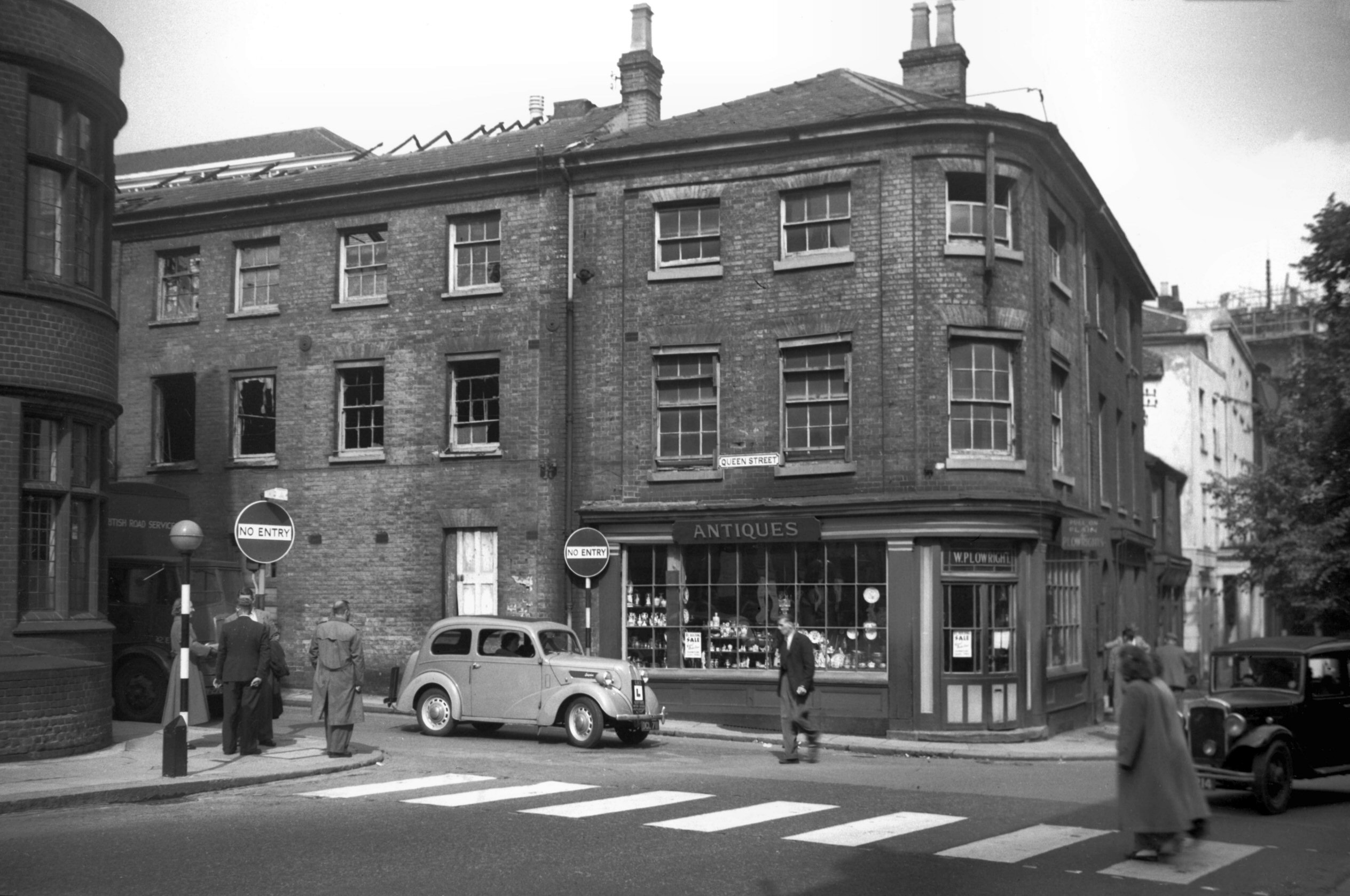
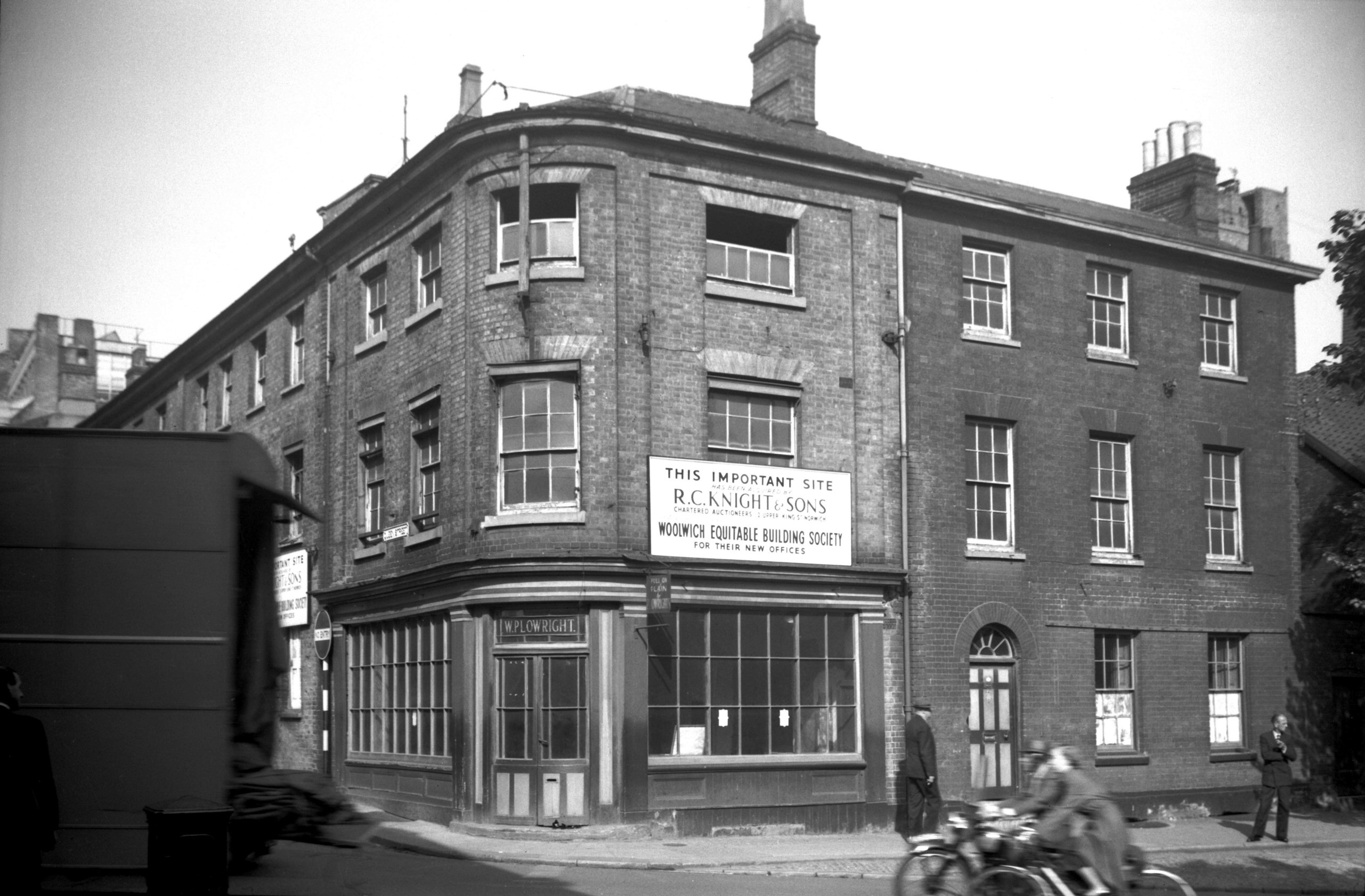
In 1911 William Robert Cremer Plowright was living just round the corner from Robert’s daughter Harriet Cremer. He was an antiques dealer with shops both at number 1 and 2 Tombland, and at 14 Princes Street – 6 doors down from Harriet at number 26. In 1931, at the age of 53, William Cremer Plowright was acquitted of manslaughter. The car he was driving on the Norwich to Bungay road overturned, killing his wife Frances. He denied the allegation that he was drunk.
William Robert Cremer Plowright died in 1955, childless, with his brother Edward Barnard Plowright as the executor of his will. Edward was also an antiques dealer, who had taken over the shop at 14 Princes Street, where he was living at his death in 1958. In the two photographs taken by George Plunkett in 1954 and 1956 the W. Plowright sign above the door of number 1 Tombland can be seen. The ‘for sale’ sign dates from just after William Robert Cremer died.
 Friends of Princes Street