Andrew Boardman II (1609-1654), a skinner from Cambridge, married Grace Harman, daughter of Thomas Harman of Norwich, also a skinner. In 1647 they bought the middle part of a messuage which was probably 24 or 22 Princes Street, Norwich.
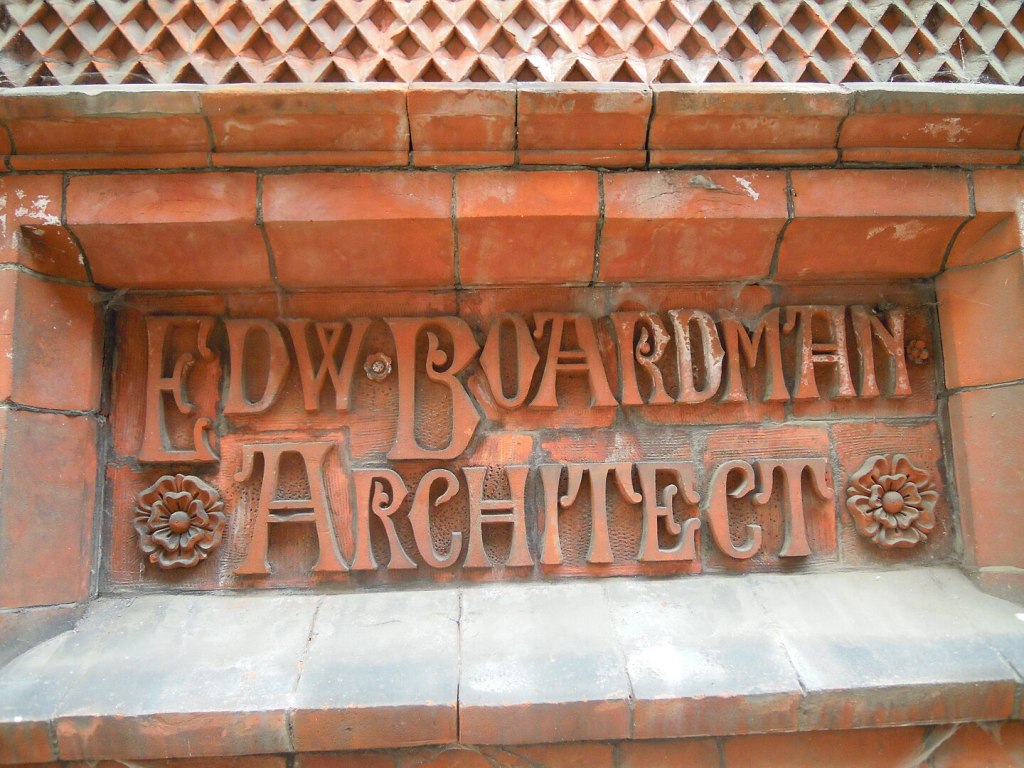
Edward Boardman (1833- 1910) was the architect who designed the rebuilt Princes Street Chapel in 1868-9. He was baptised at the chapel and was the son of James Boardman, a wharfinger of Norwich, who lived on King Street and was a deacon of Princes Street Chapel.
Were the two Boardmans related?
Andrew Boardman
1580 Andrew Boardman I (father of Andrew Boardman II) born in Cambridge
1605 Andrew Boardman marries Rebecca Wright at St Edwards, Cambridge. He is of St Clements, Cambridge
1607 Andrew and Rebecca’s son Richard is born and baptised at St Clements, Cambridge
1609 Andrew, son of Andrew and Rebecca is born and baptised at St Clements, Cambridge
1612 Thomas, son of Andrew and Rebecca is born and baptised at St Clements
1615 William, son of Andrew and Rebecca is born and baptised at St Clements.
1616 Andrew Boardman senior dies.
1617 Rebecca his widow marries Stephen Day
1622 Thomas Boardman, son of Andrew and Rebecca dies in Cambridge, aged 10.
Bef. 1635 Andrew Boardman junior marries Grace Harman, daughter of Thomas and Harman of Norwich.
1636 Ann, daughter of Andrew and Grace Boardman dies and is buried in Cambridge.
1638 Rebecca and Stephen Day emigrate to Massachusetts, with William – who later becomes a steward of Harvard University.
1638 Ann, daughter of Andrew and Grace Boardman is born and dies a few days later. Buried at St George Tombland.
1640 Rebecca, daughter of Andrew and Grace Boardman is born and baptised at St George Tombland
1643 Thomas, son of Andrew and Grace Boardman is born and baptised at St George Tombland
1647 Thomas and Anne Harman’s second daughter Anne and her husband John Linsey, a worsted weaver, sell part of their messuage in Tombland to John Tooley and Thomas Balliston who then sell in on as the mediety (middle part) of a messuage in Tombland to Andrew Boardman, skinner, married to Grace, the older daughter of Thomas and Anne Harman
1654 Andrew Boardman dies, leaves property to Grace, his widow. Money to Rebecca their daughter. Ring to his brother William (who is in America).
Grace then marries a widower, woolcomber Francis Aylmer, who has a son Philip.
1672 Grace dies
1686 Grace’s second husband Francis Aylmer dies, leaves property to his son Philip Aylmer. Buried at St George Tombland – memorial to Francis and Philip in church.
Edward Boardman
Thomas Boardman (4G grandfather of Edward) birthplace and date as yet not certain – cannot be Andrew and Grace Boardman’s son Thomas as he was born in 1643. Cannot be Thomas son of Andrew senior as he died aged 10 in 1622.
1652 Roger Boardman (3G grandfather of Edward) born and baptised at St Botolph without Bishopsgate in London of Thomas Boardman and Vertue nee Darby
1679 Thomas Boardman (2G grandfather)born to Roger Boardman and Sarah nee Hantin, baptised at Holy Trinity, Ely, Cambridgeshire.
1713 Benjamin Boardman (great grandfather) born in Bradfield, Norfolk to Thomas Boardman and Elizabeth nee Johnson, baptised at the Independent Chapel. Thomas Boardman was at Overstrand Hall.
1757 Richard Millison Boardman (grandfather) born in Great Yarmouth of Benjamin Boardman and Sarah nee Sayers
1795 James Boardman (father) born (no documentary evidence of baptism), probably in Great Yarmouth, to Richard Millison Boardman, a baker, and Emma, nee Hubbard, from a non-Conformist family. Richard Boardman, was the deacon of the Independent Meeting House there, and owner of several ships.
James Boardman is a freeman of Norwich, merchant and wharfinger and deacon of Princes Street Congregational church.
He married Frances Theobald in 1823 in St Peter Mancroft, Norwich – whose family were all baptised at the Independent Meeting House in Colegate.
1833 Edward Boardman, son of James and Frances nee Theobald, is baptised at Princes St Chapel.
1839 James Boardman dies – “of Duke’s Palace Wharf, Norwich, leaving a wife and 9 children to lament the loss of one of the best of husbands and parents that ever adorned the domestic circle. Few while living enjoyed a larger circle of acquaintance, or dying are more extensively deplored. His universal benevolence, his practical wisdom, his integrity and consistency of Christian character, secured for him the esteem and confidence of all who knew him, and occasioned to him much self-denying labour in which he had no persona! interest ; he lived for others, and his end was peace. Death-bed expressions were not needed to satisfy survivors of the safety of the departed spirit, and this is their only consolation when they review the three days that elapsed between his attack by paralysis and his release by death.”
 Friends of Princes Street