A Jewish dentist, Barnett Crawcour, was responsible for establishing the first post medieval synagogue in Norwich, on the land behind what is now No. 1 and 2 Tombland Alley and 26 and 24 Princes Street.
Barnett Crawcour was born, probably in London, in 1776, the second son of Rebecca and Samuel Zanvil Crawcour. Samuel had moved to England from Poland and had set up as a dentist in London on the Strand, regularly visiting many towns in the 1790s and 1800s, including Ipswich and Norwich. In 1775, he claimed to be a native of Hanover settled in Gloucester, and offering teeth whitening, in an advertisement in the Derby Mercury
In fact the name Crawcour is derived from Krakauer – of Krakow, the city in Poland where Samuel was born in 1748.
Presumably Samuel left Poland because of the persecution of Jews in Poland which began with the Partitions of Poland in 1772.
Samuel had several children besides Barnett – Andrew born 1773 (arrested for stealing a candlestick when drunk in 1825 in Whitechapel), Isaac (1777-1837 – also a dentist), Moses (1778-1858). Ann (Nancy) (1780-1817), Catherine (Kitty) (1782-1858), Henry (1787 in Norwich, – 1851), David (1791-1882) Sarah.
Samuel’s fourth son Moses was also a dentist, who had a house at 9 Commercial Road in London and a practice at 15 the Strand in the 1800s. He had left his house in the care of Catherine Dowse, who then stole furnishings, clothing and valuables to use as a pledge while he was travelling away with his wife to Scotland. She was found guilty and sentenced to seven years transportation.
The move to Norwich
Barnett married Fredcha bat Benjamin at the Western Synagogue in London in 1807. They had moved to Norwich by 1808, with Barnett advertising himself in the local papers as the “Surgeon Dentist from London”.
Samuel, Barnett’s father, died in Norwich in 1816.
Barnett lived at 14 Magdalen Street until at least 1832 – appearing in the local directories as Bernard Crawcour. He and Fredcha had two children, Ann born in 1810 and Henry Isaac (1813-1911). Fredcha died in April 1813, perhaps in childbirth, and was buried in the Jewish burial ground near Ber Street.
Barnett then married Fanny Alexander, in 1816 at the Western Synagogue in London. Fanny was born in London in 1794 of Joshua and Rachel Alexander. Joshua Alexander also appears to have been foreign born and Jewish.
Barnett and Fanny had 11 children – all girls apart from Samuel – Emma Esther (1817 – 1894 unmarried in Scotland), Fanny (1819 d 1917 in Glasgow), Rebecca (1821-1889), Eliza (1823 – 1856) who married Samuel Barczinsky, a school master who was born in Poland, Martha (1825-1870) possibly married Samuel Lazarus, Hannah born 1827 married Benjamin Simons, widower and ship owner from Glasgow in 1861 – lived in Glasgow Scotland from 1871, Samuel born 1828 – by 1861 living in Camberwell as a Hosier (?) with Emily his wife, Martha his sister, Emily his niece and a servant., Sarah born 1830, Rosina born 1831, Adelaide born 1833 and Anna born 1834.
The hoax
In 1820, Barnett and Fanny received an invitation to attend a mayoral banquet, only three days before it was due to be held. Crawcour ordered a new suit for the occasion, but it turned out the invitation was a hoax, perpetrated by a well-known local practical joker, Mr Smith. Crawcour went to the city sessions to recover the hundred shillings the new suit had cost but was awarded damages of only 1 shilling.
Serjeant Blosset noted that there was a funny side to the case, and the court reporter thought he saw the Serjeant heaving with laughter too, but as the Serjeant said “if you do laugh, let me put it to your minds, as reasonable men and men of feeling, whether you would consider there can possibly be any real fun in enjoying the mortification of our neighbour.”
The Chief Justice’s summing up was quite clear that “whether Jew or Christian was of no consequence. In my mind the expense incurred for the clothes is a light part of the defendant’s conduct when compared with the vexation the plaintiff’s feelings must have experienced, and particularly in remembering it done not in an unguarded moment, or in a moment of intemperance but coolly and deliberately, which was proved by his having said he would rather undergo transportation than not see the Plaintiff at the door in his pumps and opera hat.”
The defence pointed out that the order for a suit was not cancelled once Barnett Crawcour realised that the invitation was a hoax and that the suit itself was of every day use rather than a special one to be “laid in lavender”. He also rather snidely wondered why such a devout Jew would think himself of the social class that would be invited to such a banquet, and where he might have to eat food such as venison and turtle.
So the award of a shilling by the jury perhaps acknowledges the hurt feelings. They found the defendant guilty, but not to the extent of making the defendant pay a 100 shillings fine – around £200-£300 in today’s money.
The synagogue
A month after the verdict, Barnett was involved in a traffic accident, and one of his legs had to be amputated. These humiliations and setbacks seem to have made him determined to fight for his social status and economic standing. In 1823 he started an appeal for funds to acquire land and build the synagogue, which was finally opened in 1828 for a congregation of around 28 people. The first minister was Judah Leib ben Mordecai (1784-1844), licensed by the Chief Rabbi in 1823 as shochet in Norwich.
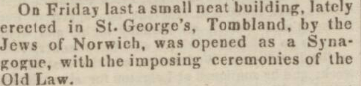
It was a small, simple, brick built top lit room, which survived until the 1960s. Barnett passed the lease of the synagogue to Isaiah Jones, a fellow dentist, in 1830 but Isaiah Jones moved to London, and the synagogue became disused from 1849, after another synagogue was built in St Faith’s Lane in 1848.
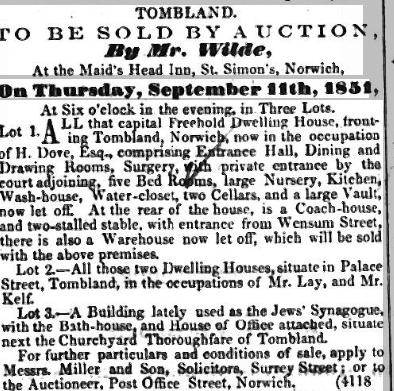
In 1851 April and September the synagogue, bath house (mikveh) and house of office (means toilet or outhouse) – was put up for sale:
The only existing drawings of the Tombland Alley synagogue are from 1951, when it was being used as a coke store.
Barnett’s place in dental history
In 1830, Barnett Crawcour made a discovery which “ensured his place in dental history”. He invented what he called a mineral succedaneum – a primitive amalgam filling. It was made of mercury combined with silver, coarsely filed from French coins. It was comparatively cheap, but profitable.
Crawcour took out advertisements in the local newspapers to advertise his cut price fillings and a fight started between Barnett and other dentists who claimed that the amalgam was unstable, and resulted in mercury poisoning.
Barnett’s brother Moses was one of the “Messrs Crawcour” (wrongly described as brothers from France) who took Royal Mineral Succedaneum to the USA and became caught up in the “amalgam wars”. The other “brother” was Moses’ nephew Edward Crawcour (1813-1865), son of his brother Isaac. Edward was based in Scotland, having married Margaret Buchanan. They had two children but Margaret died in 1840 at the age of 36. Edward appears to have moved back to London and was named in a paternity suit in 1845 by Peachy Tryon of Edinburgh of a child born in that year. He died in 1865.
The amalgam wars seemed to have worn down Barnett Crawcour, and he died in 1834, aged 58. Moses was one of the executors of his will, which left everything to Fanny. Moses died in 1858, executor was his nephew, Barnett’s son, Isaac Henry Crawcour of 4 America Square Minories, a dentist. Effects under £12,000.
After Barnett’s death
(Isaac) Henry Crawcour, only 21 at the time of his father’s death, took out an advertisement to say he was continuing the dentistry practice. However by 1845 he had moved to London, living in Shadwell near St Georges in the East, practising dentistry.
Henry Crawcour was arrested in 1845 on suspicion of burglary of a local schoolmaster, James Starke’s house. The testimony of Edward Cummings, who claims to have seen Henry Crawcour at the door of the schoolhouse, holding a candle and letting two people out, was clearly not believed, as Henry Crawcour was acquitted. Cummings says he knew “Crawcour, the Jew, before” “I knew the Jew’s face as soon as I saw him—I knew something wrong was going on”. However Crawcour and Hankins, the other person Cummings claimed he had recognised both had alibis and the fruit and nut boy that Cummings said he was with when he saw the suspects denied that Cummings was there at the time and place he described. “Several respectable witnesses gave the prisoner Crawcour an excellent character”
Henry married Jane Mann (b 1822), daughter of John Mann, a farmer in 1856 at St Simon Zelotes church in Bethnal Green, London. In 1871 Isaac H was living in Lambeth as a tobacconist, with Jane and nephew Harry Alexander In 1881 they were living in Dagmar Road in Camberwell. Isaac is described as a provision merchant. 1891 in Balfour Road, Camberwell. He died in 1911 with wife Jane as executor, £33 11s 3d effects. Jane died in 1920 aged 97, probate to William Alfred Wilson.
Fanny, Barnett’s widow moved to Kent after Barnett’s death. Her daughter Eliza’s husband Simon Barczinsky was a teacher at May House school in Gravesend. She lived with her daughters Emma, Fanny, Rebecca, Eliza, Martha, Anna, Sara. Reuben Alexander her brother and also husband of Ann Crawcour, daughter of Barnett’s first marriage, was also living in Kent working as a clothier, with his children and Joshua the father of Fanny and Reuben. By 1871 Fanny had retired but was still living with her daughters Emma, Fanny, Rosina and Laura, and a servant in Glasgow. Fanny died in 1885 in Glasgow. Her daughter Esther Emma was an executor of her will.
Barnett’s second son Samuel Walter Crawcour married Emily Barnes in 1860 in the parish church of Tottenham.
 Friends of Princes Street