Pre-Reformation connection to St Mary in the Fields
1272 – John Le Brun, a priest, gives the college of St Mary in the Fields (where the Assembly House now is) the advowson of St George at Monastery Gates (now St George Tombland) – possibly inherited from his father. It included 3 messuages – which may have included 20-26 Princes Street.
The medieval hall style building at the back of 26 Princes Street, in Tombland Alley, could have been the rectory of St George. (p.378 History of Norfolk, Blomefield)
16th century rebuilding and Augustine Steward
1507-8 at least two fires broke out, the second one devastating St George Tombland and other parishes.
1538 Augustine Steward asks for reduction of rent on Princes Inn estate because it is a void messuage.
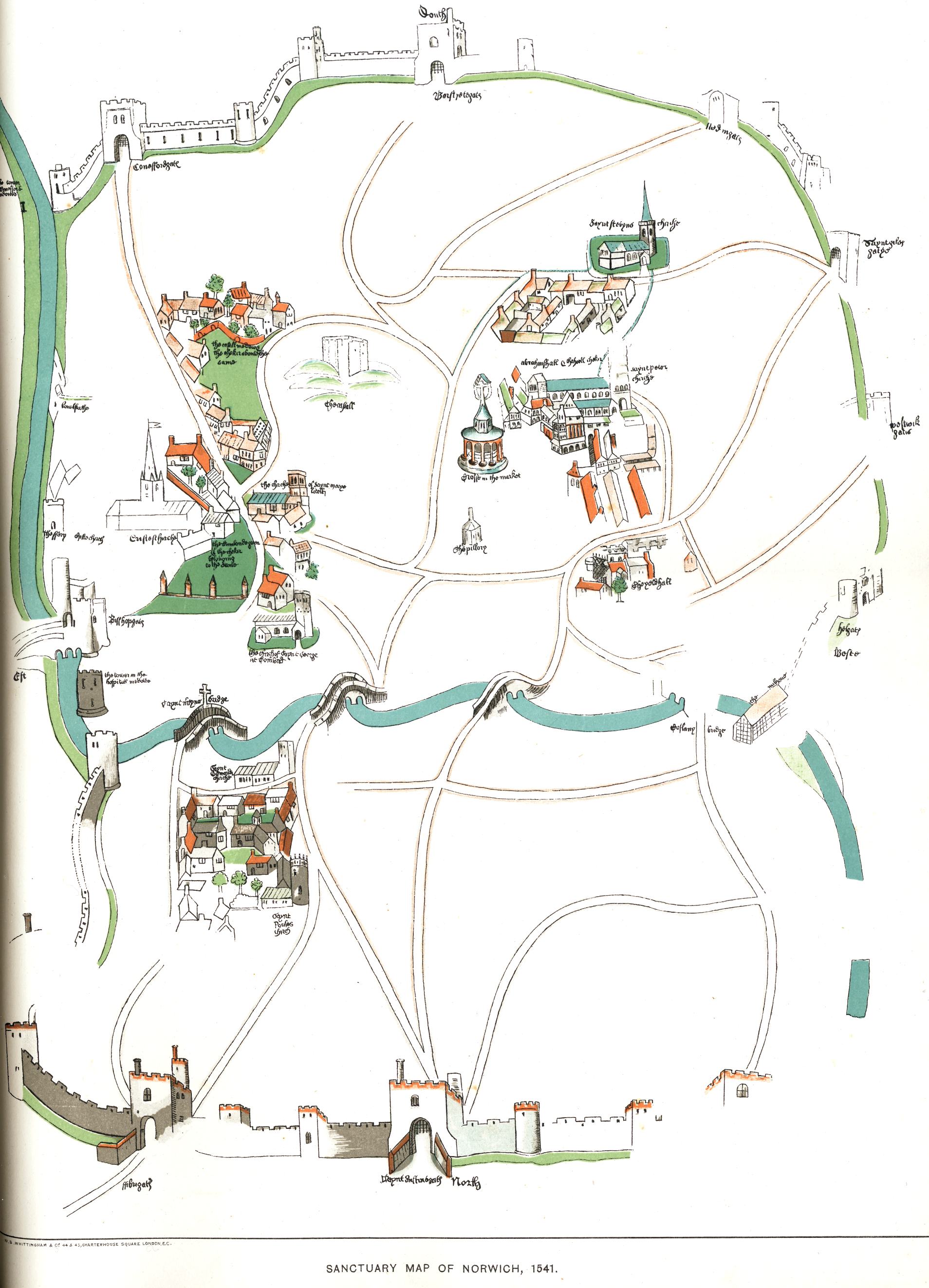
1541 Sanctuary map made to show metes, bounds, and areas of sanctuary within the city; ordered by commission from the king to the mayor of Norwich dated 10 February, 3[2] Henry VIII , following Act of 1541 to restrict rights of sanctuary. Indicates St George Tombland and neighbouring buildings are sanctuaries.
1545 the chapel and college of St Mary in the Fields were surrendered to the crown and the chapel and cloister destroyed. The remaining buildings were granted Dr Miles Spencer, who used the college as his private residence. The rest of the property included three messuages at St George’s and their gardens and orchards. (Blomefield). This may have been Princes Inn, 22-26 Princes Street/Tombland Alley and what became Augustine Steward’s House and the Samson & Hercules, which Spencer leased or sold off.
Before 1565 Miles Spencer sells two tenements to John Clarke/Clerke, a cook, and his wife Elizabeth, nee Clarke
1565 – John and Elizabeth Clerke grant to Augustine Styward a tenement and garden (which the said John and Elizabeth Clerke bought of Miles Spencer; LL.D.) between a tenement of the said John Clerk E(ast)., a tenement of the said Augustine Styward W(est), a garden of the said Augustine Styward N(orth), and a highway S(outh). Possibly = sale of 22 to Styward and continuing to live in 24 and 26 Princes Street
1582 Francis Clarke of Gasthorpe, a clergyman, purchases two messuages (24-26?) in St George Tombland from his sister Elizabeth Clarke – widow of John Cle/arke, now married to Edmund Bradye, an innhoulder. Properties are between William Styward/Steward to the west, cemetery of St George Tombland to the east, and the garden of William Styward to the north, with the highway (Princes Street) to the south. In the tenure of William Pyckering (?-1598), a barber.
17th century – The Clarkes, Harmans and Aylmers
1616 Francis Clarke, clergyman, dies in Riddlesworth, Norfolk. To Francis his son, tenement in St. Lawrence, Norwich, and property in Knettishall and Hopton; Mary, dau., two tenements in Tombland together; Elizabeth, dau., Gasthorpe property; Alice, dau.; Alice, wife, sole executrix. His daughter Mary Leggett inherits 24-26 Princes Street.
1624 Mary Leggett nee Clarke sells 24-26 to Thomas Harman, skinner, and his wife Anne. The two tenements are to the east of Richard Harman’s tenement, which used to belong to William Styward, then Robert Brecles, then John Clarke. To the east is the cemetery of St George Tombland and to the north is land formerly belonging to William Styward, then William Pyckering (barber) and now Richard Brice, with the highway to the south.
1606-1626 landgable. Richard Harman and Anne Harman, widow, own tenements (probably 22-26) which used to belong to William Styward, adjoining the property which used to belong to the dean of Chappell of Field (Miles Spencer), with Princes Inn on the West and the Churchyard of St George Tombland on the east and the highway south.
1627 Thomas Harman dies, buried in St Mary in the Marsh church in the Cathedral precinct. Wife Anne is left his messuages in Tombland and in St James.
1646 Anne Harman dies
1647 Thomas and Anne Harman’s second daughter Anne and her husband John Linsey, a worsted weaver, sell part of their messuage in Tombland to John Tooley and Thomas Balliston who then sell in on as the mediety (middle part) of a messuage in Tombland to Andrew Boardman, skinner, married to Grace, the older daughter of Thomas and Anne Harman
1654 Andrew Boardman dies, leaving his wife Grace as executrix of his will and inheritor of his St George Tombland property. Grace then marries a widower, woolcomber Francis Aylmer, who has a son Philip.
1661 Francis and Grace Aylmer transferred ownership of the messuage in Tombland (20 or 22 to 26) where they were living to Richard Lynsey/Linsey, another woolcomber, who was married to Rebecca, the daughter of Andrew Boardman and Grace. This messuage was situated between the churchyard on the east, a messuage owned by Thomas Fairecloth and Prince’s Inn to the west, the king’s highway [Princes Street] to the south and the garden late of Edmund Brice, deceased, to the north. This was done as a quit claim, in default of the £100 not paid as per legacy of Andrew Boardman. Two days after, Richard and Rebecca sold the messuage back to Francis and Grace.
1672 Grace Aylmer dies at age of 59
1686 Francis Aylmer dies at age of 58. Son Philip (1648-1727) inherits properties. Buried at St George Tombland – memorial to Francis and Philip in church.
1727 Philip Aylmer dies – Francis, his son, inherits all property. Possibly sells off part of it, to the Harveys, as is living elsewhere.
1758 – Francis Aylmer dies. His only child Elizabeth, aged 12, inherits all his property. Some of it may have been sold to the Harveys.
18th century – the Marshes – coaching, public houses and an excise office
Robert Harvey seems to have sold 24-26 Princes Street to Robert Marsh or maybe to his nephew Charles Marsh.
1771 Robert Marsh Esq, former Mayor of Norwich, dies at the age of 92, and leaves his messuages and tenements in St George Tombland to his nephew, Charles. He left instructions in his will that he should be buried at St George Tombland, where he was also baptized.
1779 Edward Peterson & Co “importers of Spirituous Liquors” announce that they were taking over a warehouse next to the excise office – this may have been the hall at the back of number 26, which would at that time have been a separate building with its own doorway onto Tombland Alley.
1780 August – an advertisement was placed by Thomas Blake senior and junior, for a public house, to be let, late the Six Bells, and now the Horse and Groom [possibly 24 or 26 or 1 Tombland Alley], with the Dwelling house adjoining [possibly 24 or 26 or 1 Tombland Alley], situated in St George’s of Tombland, and now in the Occupation of Mr James Beevor, or his undertenants. James Beevor was a beer brewer who lived in St Saviour (on Magdalen Street). He sold his brewery business to John Patteson in 1794. He was the younger brother of Sir Thomas Beevor.
1783 24 and/or 26 may have been the Excise Office and residence of the Excise officer John Snelgrove on Excise Office Street
1784 Horse and Groom was 24 and 26 Princes Street according to Tillett (NB he is incorrect about the location of the White Horse)
1788 6s 1d paid by the churchwardens of St George Tombland for repairing windows at the Horse and Groom, broken doing repairs to the church.
1789 Charles Marsh, owner of 24-26 Princes Street dies, aged 78.
1790 Charles Marsh‘s estate is put up for auction, including Snelgrove’s former residence and office, described as “a dwelling house and garden, with a large store cellar” with a yearly rent of £33.
1806 August – “On Tuesday last, Mr William [sic] Murrell of the Horse and Groom Inn, St George’s Tombland, to Miss Beane, of the same parish” marriage
19th century – living above the shop and the synagogue
1817 – A release and covenant dating from 2nd January 1817 records that Gibbs Leeds (presumably III) paid £250[1] to the Harvey brothers (Robert, John and Charles Harvey[2]) to buy the messuage or dwelling house and shop in St George Tombland in the occupation of Leeds, bounded by premises of Hewett Rand (north – Samson and Hercules court), premises of John Sayer Reeve, Rizen Mollett and Elizabeth Aylmer (east), Kings Highway (south) and a messuage called Princes Inn (west). See 1837 sale of what is definitely 22, formerly owned by Gibbs Leeds. So it could be that John Sayer Reeve had premises in 24-26 and 1 Tombland Alley, Rizen Mollett was in the old Augustine Steward House, and Elizabeth Aylmer was in 2 Tombland Alley. Rizen Mollett was a range and stove manufacturer and ironmonger and his shop premises at this point were on Tombland itself – probably the front part of the Augustine Steward house. John Sayer Reeve was a baker with a shop on Coslany Street in St Mary Coslany.
1827 – sale of a freehold dwelling house (24-26?), lately occupied by Mr Buttifant, and his under-tenants, with a stable and yard adjoining, situate in St George of Tombland, Norwich, fronting Prince’s Street and lying next the Church Alley. The situation of these premises is well adapted for a druggist’s or grocer’s shop, or any retail trade” Norfolk Chronicle.
1841 census – Charles Raven, 45, Unemployed (formerly wine merchant, bankrupt), Ann Raven, 30, Henry Raven 11, Ellen Raven, 10, Susan Raven, 9, Anna Raven 7, Charles Raven, 5, John Raven, 1.
1851 April – 24 (Lot 1) and 26 Princes Street (Lot 2) and the synagogue in Tombland Alley (following death of William Rackham) put up for sale

1851 census – Fred M. Smith, 24, clothier and draper, Mary A, wife, 20, Mary A, daughter, 6 months, Jane Parnall, servant, 19.
1861 census – Frederick Cogman, tailor, 39, master employer, Emma, wife, 49, dressmaker, Lewis, son, 15, clerk at factory, Sidney, son, 11, Walter, son, 10, Arthur, son, 8, Eliza, daughter, 4, Frederick, son, 2, Emma Warren, servant, 15, Rebecca Campling, servant, 20.
by 1864 Robert Rolfe Cremer owned 26 Princes Street but lived on Magdalen Street, Frederick Cogman also owned and lived in a property on Princes Street
1871 census “Temporarily absent”
1881 census – Anne L Palmer, lodger, widow, 47 and Susan Massey, sister, unmarried, 68
1882 Register of electors for Princes Street – Frederick Cogman (house) Fidelis Spaul (house), Reginald Daynes Brett (house and shop), Robert Thorndick Dawson (house). Robert Cremer living on Magdalen St, qualifying property in Princes Street
1891 census – Robert R Cremer, widower, medical practitioner, retired, Harriet, daughter, 41
20th century – council offices and landlords
1901 census Graeme [sic] Princes Street Harriet Cremer (presumably 26), 48, living by own means
1905 26 Princes Street sold by auction – in the occupation of Miss Mabel Chapman, a dressmaker, at a rent of £14 per annum. Included 1 and 2 Tombland Alley and the parish room in Tombland (the synagogue?)
1911 census 24 and 26 are offices of the city council
1911 Miss Mabel Helen Chapman, dressmaker
1912 24 Princes Street – Weights & Measures Office – through to 1914
1914 24 Weights & Measures, 26 M Chapman
1916 26 Princes Street – Thomas Edwin Thomas, artificial teeth manufacturer
1921 Harry King, 43 year old baker and family
1924 1926 Harry Robert King to 1927
1924 conveyance between Queenie Ballard and Arthur Holmes – 26 Princes Street deed
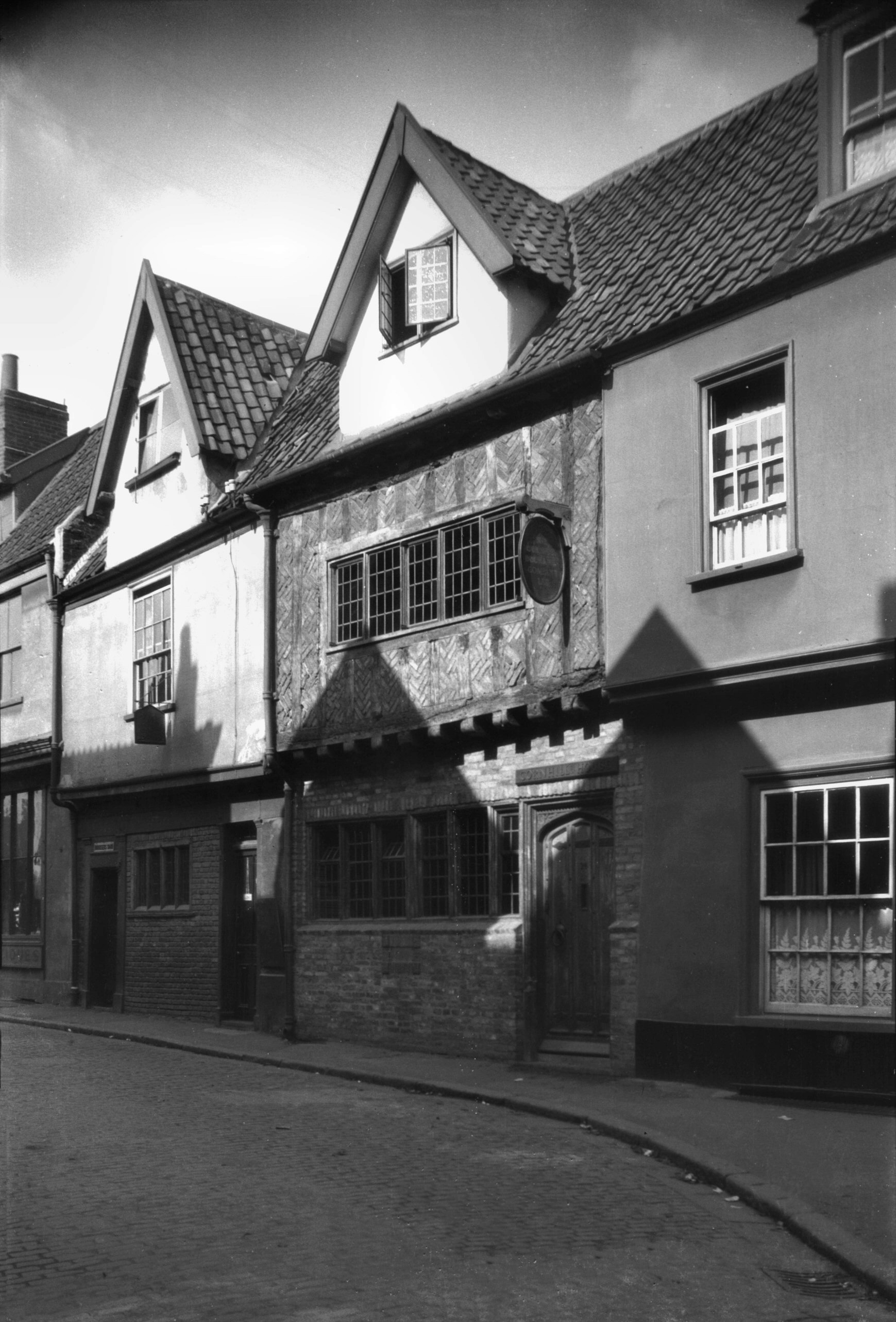
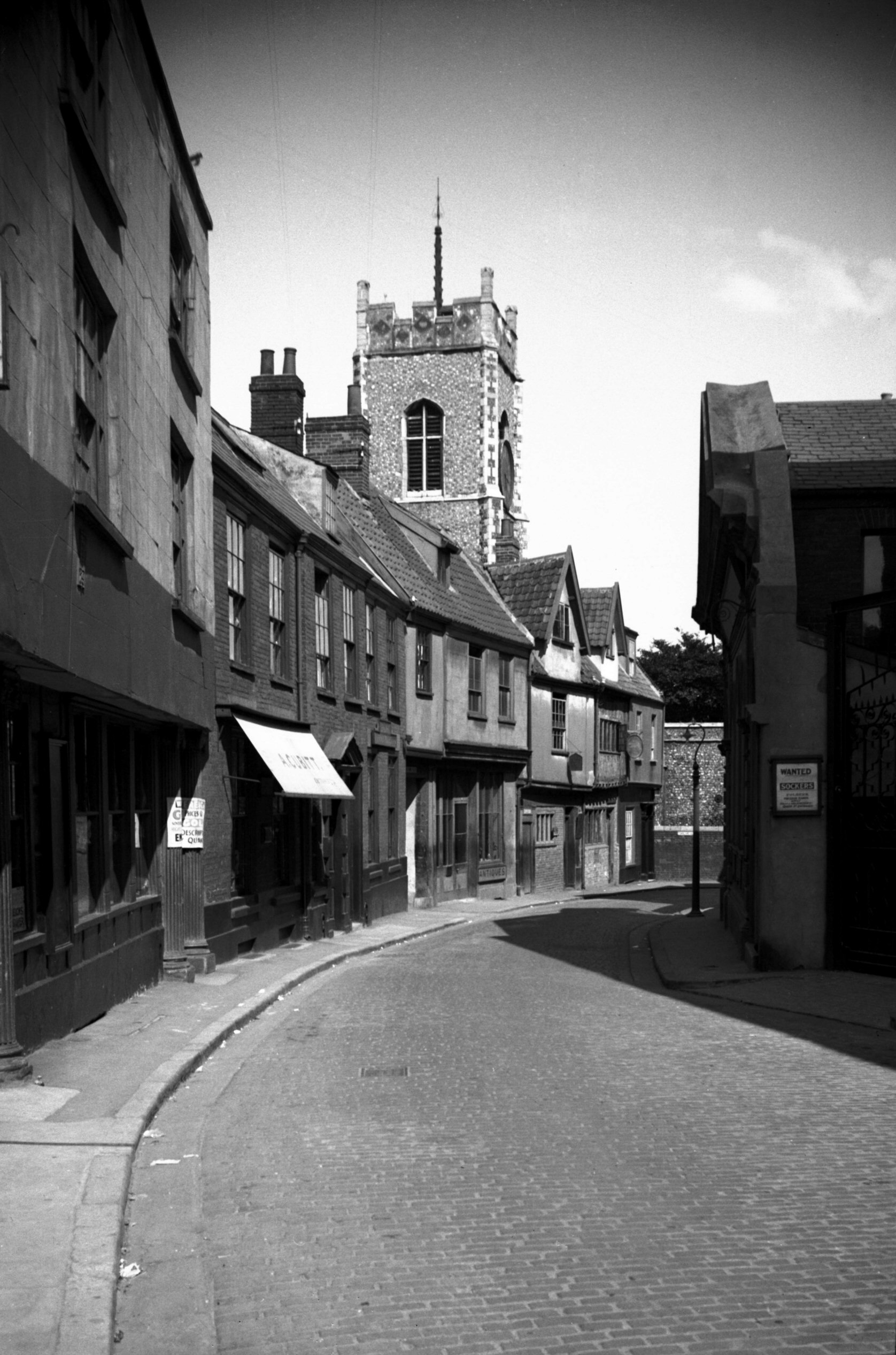
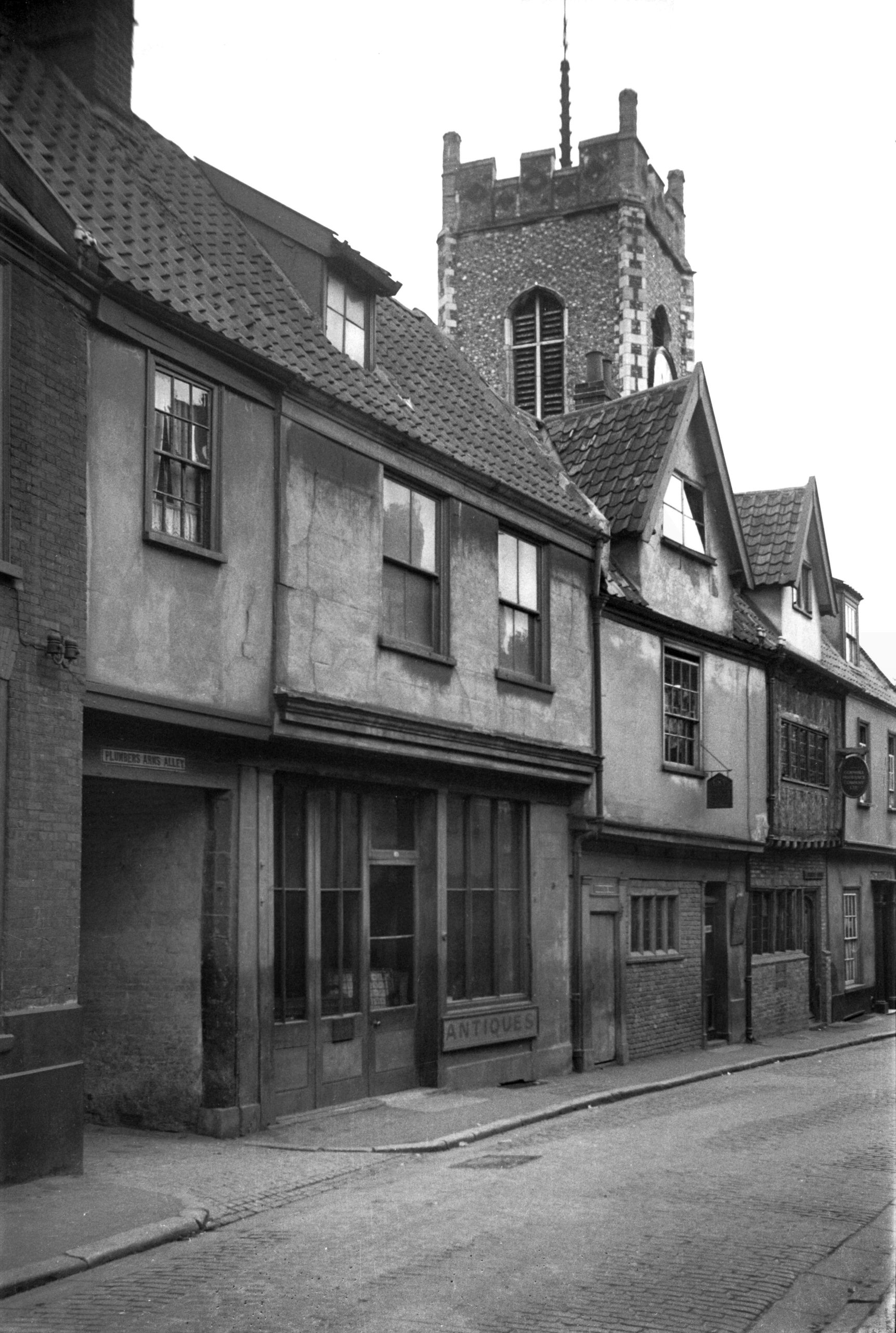
1934 George Plunkett photograph
1935 George Plunkett photograph
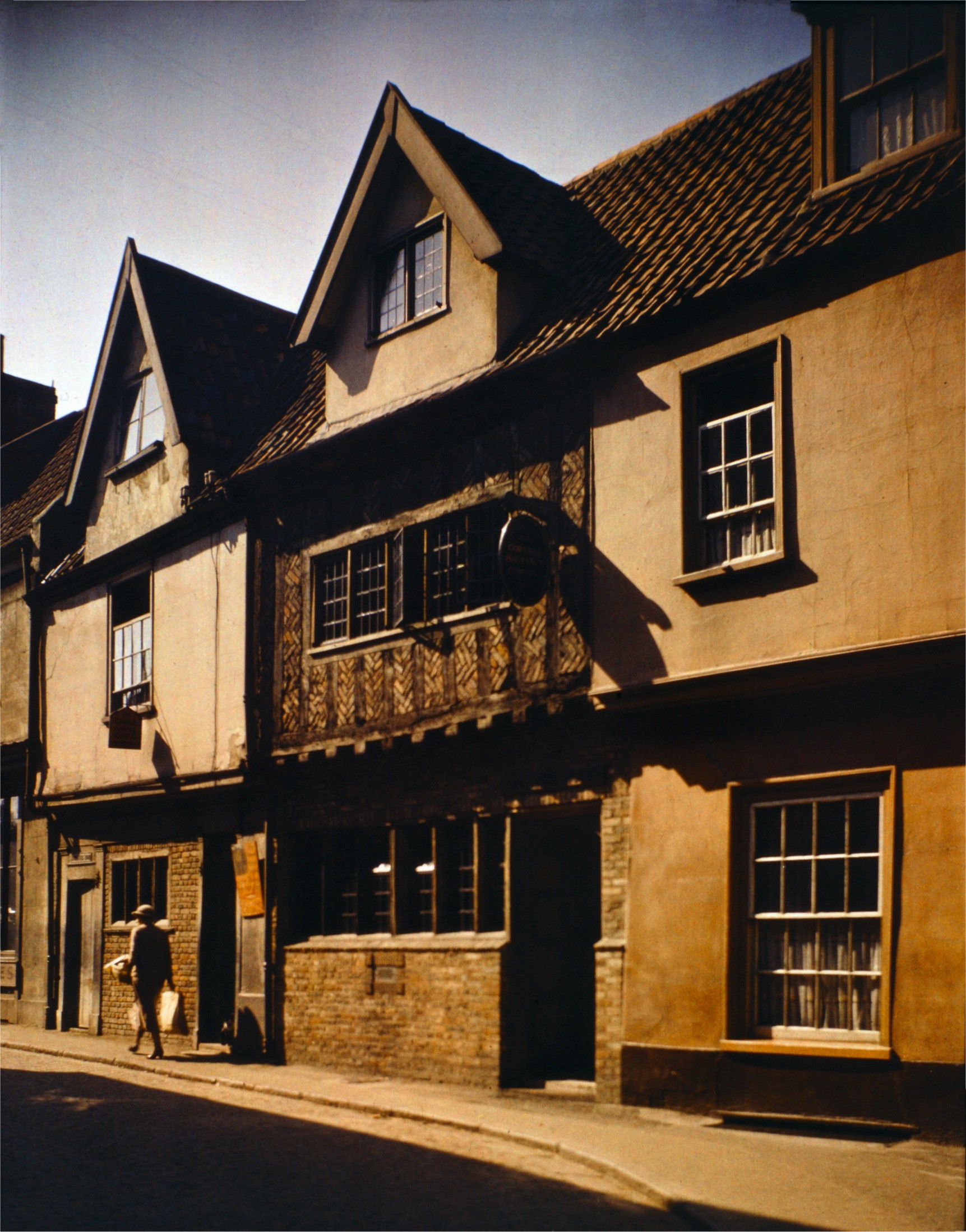
1936 George Plunkett photograph (colour)
1936 George Plunkett photograph
1937 Bernard Ashton Turner
1939 Bernard and Beatrice Turner. Bernard described as having private means – presumably rent from his properties. Bernard’s brother Albert is running an antiques shop at number 20
1941-7 Bernard Turner
The 1955 restoration and Cornhill Insurance
1955 Bernard Ashton Turner sells 26 Princes Street and 1 Tombland Alley to Cornhill Insurance, but continues to own 2 Tombland Alley
1955 Cornhill Insurance commission architect Cecil Upcher to restore 26 Princes Street and merge it with 24 Princes Street again. A long Tudor window frame was found and left in position, but otherwise the restoration preserved the Georgian makeover, retaining the Georgian doorway, sash windows and bannister. More chimney stacks removed. Timber panelling repaired and reinstated in front office in 26. Ground floors to be screed and cement with cork overlay.
The correspondence between Upcher, Cornhill Insurance and Richard Carter, the builder, for the 1955 refurbishment of 26 and 1 Tombland Alley show that the two buildings were joined together by this point, but the hall part had its own separate door and the ground floor was divided into two rooms. Upcher and Carter replaced the external door at the north end of 1 Tombland Alley with a window and removed the staircase going up from 1 Tombland Alley into the attic. Two sash windows replaced the previous window in 1 Tombland Alley, looking onto the alley. They also turned the external door in the hall into a window.
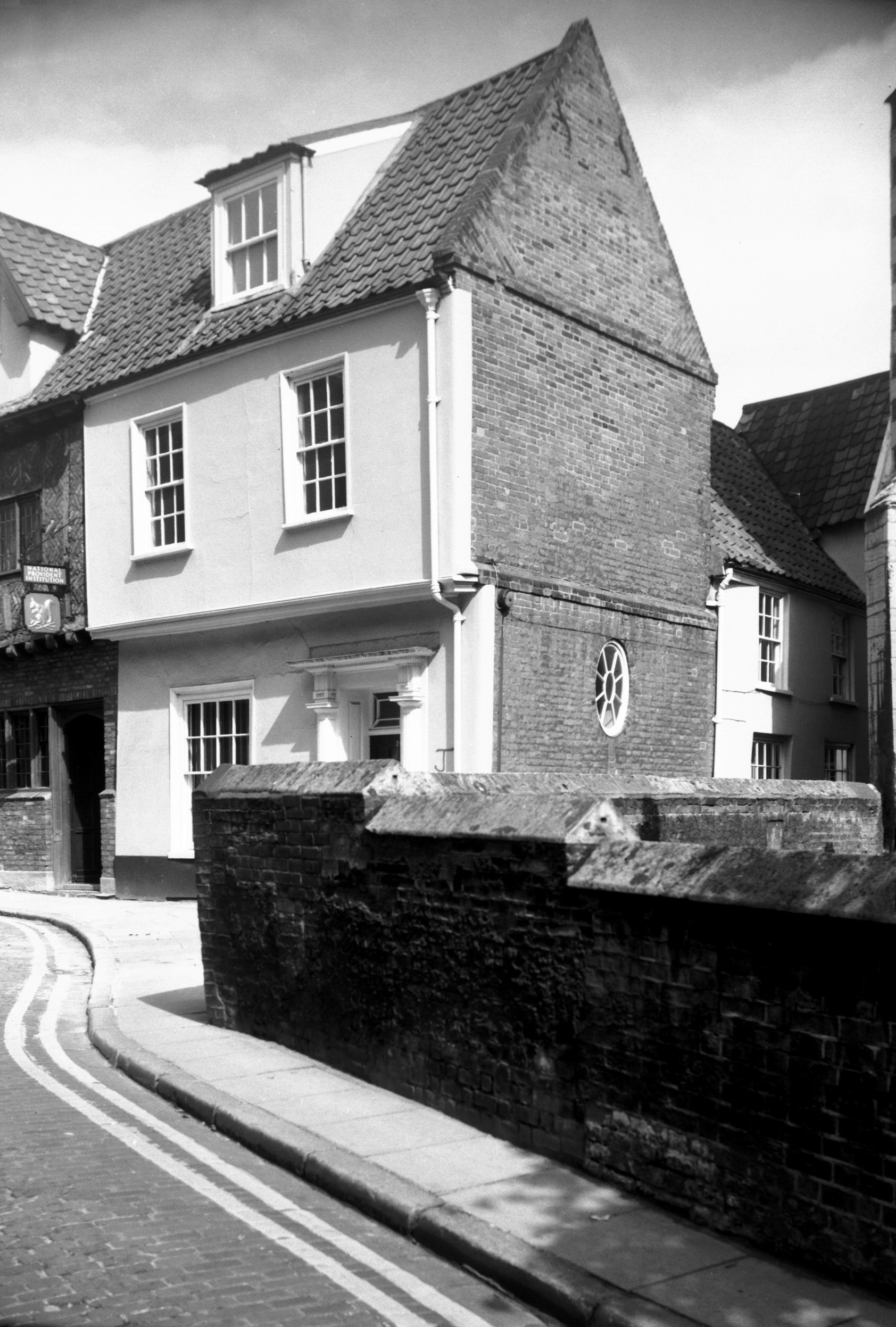
There were also two chimneys at 26 Princes Street and 1 Tombland Alley which have now been removed. The one on the east end of 26 Princes Street was removed some time before 1955, possibly due to war damage. Upcher had the east wall rebuilt, using the old bricks, and adding the oval window. The fireplace for the east wall chimney is still intact in the front bedroom of 26 Princes Street.
The flues of the fireplaces in the front ground floor and also in the ground and upper floors of the old hall were apparently both going to the same stack as three flues on the ground floor, first floor and second floor at number 24. The fireplaces in the hall part of 26 were removed during the 1955 restoration. The ground floor fireplace was no longer functional by 1955 and had been boarded up – this was reopened and a new fire surround added, but purely as a decorative feature. The boards covering the old panelling in the front office were also removed, and a new way cut from 24 to 26 through the adjoining wall, replacing what was previously a “secret panel”.
A window was added to the upper floor of the hall, overlooking the courtyard, apparently in keeping with traces of a former window opening in the wall.
There were separate Gentlemen and Ladies toilets in the courtyard, for the employees of the Cornhill Insurance Company at 24. The toilet on the ground floor of 1 Tombland Alley was removed and a doorway opened up to the courtyard so the employees at 26 could also make use of the toilets.
The chimney and fireplace at 1 Tombland Alley was also removed in 1955 and the niche in the wall of the ground floor of 1 Tombland Alley was opened up.
1955 – claim to the War Damage Commission resulted in payments to repair cracks, loose plaster and damage to the friezes in the hall and in the first floor front bedroom of 26. However, the Commission refused to pay for the defective gable wall.
1956 Oval window inserted in east wall of 26, using old bricks. Toilet in kitchen of 1 Tombland Alley removed. Windows inserted. Cellars of 24 and 26 joined together. Consolidated and filled in an old well. Opened up and formed a plaster niche.
1956 An old stone bowl with two handles was found buried in the walls of 26 Princes Street, in three pieces. Upcher didn’t want it so asked that it was left there. The museum said it was medieval oolite.
1960 24 and 26 are Cornhill Insurance
1966 MW Innes, architect and Lambert, Christopher and Parker, architects.
1967 Chandler Hargreaves Whittall and co, insurance brokers – to 1971
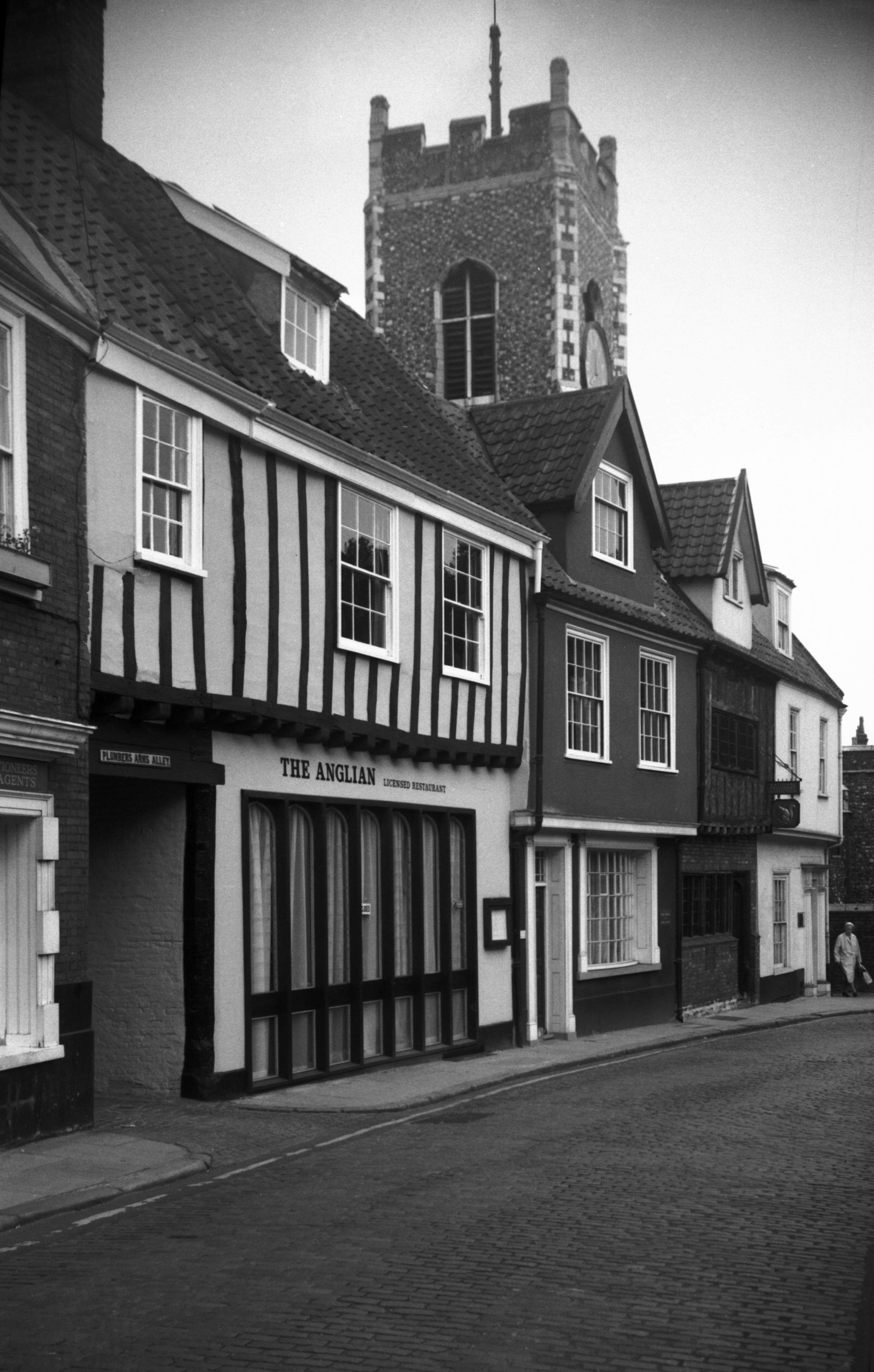
1970 George Plunkett photograph
1972/3 Clapham & Collinge, solicitors
1979 Planning permission granted to National Provident to extend 24-26 as a single storey to provide staff facilities (24 and 26 were combined again at some point between 1973-1979?)
1986 George Plunkett photograph
2001 – 2003 24 and 26 Princes Street, along with 1 and 2 Tombland Alley were converted from offices back into two houses. The single storey extension behind 24 was turned into a two-storey extension.
 Friends of Princes Street