1272 – Le Brun gives the college of the Chapel in the Fields the advowson of St George at Monastery Gates (now St George Tombland) – possibly inherited from his father. It included 3 messuages, possibly including what is now the 22-26 Princes Street building and the area behind.
1507-8 at least two fires broke out, the second one devastating St George Tombland and other parishes. Augustine Steward may have acquired 22-26 Princes Street.
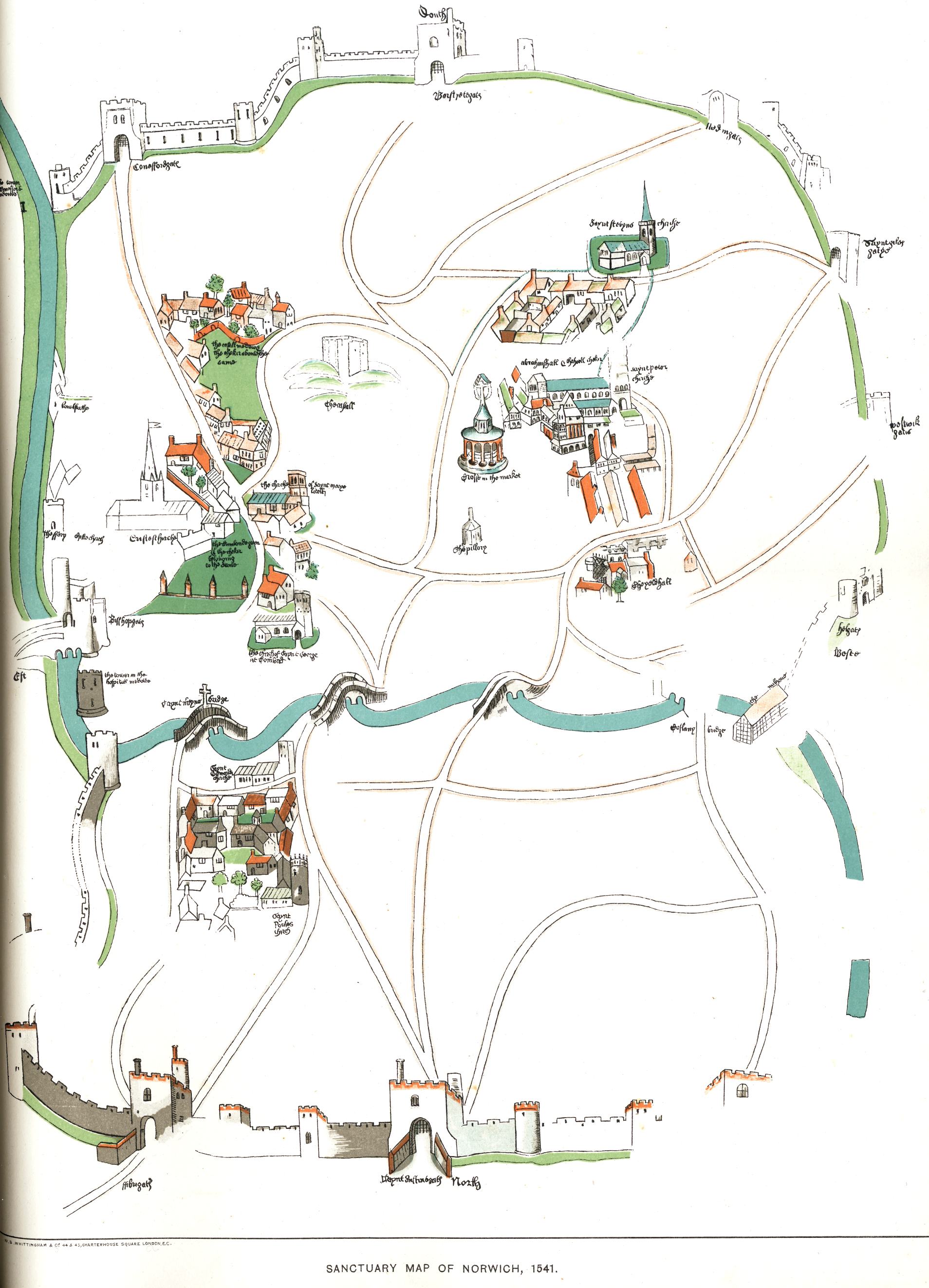
1541 Sanctuary map made to show metes, bounds, and areas of sanctuary within the city; ordered by commission from the king to the mayor of Norwich dated 10 February, 3[2] Henry VIII , following Act of 1541 to restrict rights of sanctuary. Indicates St George Tombland and neighbouring buildings are sanctuaries.
1545 the chapel and college of St Mary in the Fields were surrendered to the crown and the chapel and cloister destroyed. The remaining buildings were granted Dr Miles Spencer, who used the college as his private residence. The rest of the property included three messuages at St George’s and their gardens and orchards. (Blomefield). This may have been Princes Inn, 22-26 Princes Street/Tombland Alley and what became Augustine Steward’s House and the Samson & Hercules, which Spencer leased or sold off.
Before 1565 Miles Spencer sells two tenements to John Clarke/Clerke, a cook, and his wife Elizabeth, nee Clarke
1565 – John and Elizabeth Clerke grant to Augustine Styward a tenement and garden (which the said John and Elizabeth Clerke bought of Miles Spencer; LL.D.) between a tenement of the said John Clerk E(ast)., a tenement of the said Augustine Styward W(est), a garden of the said Augustine Styward N(orth), and a highway S(outh). Possibly = sale of 22 to Styward and continuing to live in 24 and 26 Princes Street
1582 – Francis Clarke of Gasthorpe, a clergyman, purchases two messuages (24-26?) in St George Tombland from his sister Elizabeth Clarke – widow of John Cle/arke, now married to Edmund Bradye, an innhoulder. Properties are between William Styward/Steward to the west, cemetery of St George Tombland to the east, and the garden of William Styward to the north, with the highway (Princes Street) to the south. In the tenure of William Pyckering (?-1598), a barber.
1616 Francis Clarke, clergyman, dies in Riddlesworth, Norfolk. To Francis his son, tenement in St. Lawrence, Norwich, and property in Knettishall and Hopton; Mary, dau., two tenements in Tombland together; Elizabeth, dau., Gasthorpe property; Alice, dau.; Alice, wife, sole executrix. His daughter Mary Leggett inherits 24-26 Princes Street.
1624 – Mary Leggett nee Clarke sells 24-26 to Thomas Harman, skinner, and his wife Anne. The two tenements are to the east of Richard Harman’s tenement, which used to belong to William Styward, then Robert Brecles, then John Clarke. To the east is the cemetery of St George Tombland and to the north is land formerly belonging to William Styward, then William Pyckering (barber) and now Richard Brice, with the highway to the south.
1606-1626 landgable. Richard Harman and Anne Harman, widow, own tenements (probably all or part of 22-26) which used to belong to William Styward, adjoining the property which used to belong to the dean of Chappell of Field (Miles Spencer) (1 Tombland Alley? The old rectory?), with Princes Inn on the West and the Churchyard of St George Tombland on the east and the highway south.
1627 Thomas Harman dies, buried in St Mary in the Marsh church in the Cathedral precinct. Wife Anne is left his messuages in Tombland and in St James.
1646 Anne Harman dies
1647 Thomas and Anne Harman’s second daughter Anne and her husband John Linsey, a worsted weaver, sell part of their messuage in Tombland to John Tooley and Thomas Balliston who then sell in on as the mediety (middle part) of a messuage (could be 24) in Tombland to Andrew Boardman, skinner, married to Grace, the older daughter of Thomas and Anne Harman
1654 Andrew Boardman dies, leaving his wife Grace as executrix of his will and inheritor of his St George Tombland property. Grace then marries a widower, woolcomber Francis Aylmer, who has a son Philip.
1661 Francis and Grace Aylmer transferred ownership of the messuage in Tombland (some or all of 22 to 26) where they were living to Richard Lynsey/Linsey, another woolcomber, who was married to Rebecca, the daughter of Andrew Boardman and Grace. This messuage was situated between the churchyard on the east, a messuage owned by Thomas Fairecloth and Prince’s Inn to the west, the king’s highway [Princes Street] to the south and the garden late of Edmund Brice, deceased, to the north. This was done as a quit claim, in default of the £100 not paid as per legacy of Andrew Boardman. Two days after, Richard and Rebecca sold the messuage back to Francis and Grace.
1672 Grace Aylmer dies at age of 59
1686 Francis Aylmer dies at age of 58. Son Philip (1648-1727) inherits properties. Buried at St George Tombland – memorial to Francis and Philip in church.
1727 Philip Aylmer dies – Francis, his son, inherits all property. Possibly sells off part of it, to the Harveys, as is living elsewhere.
1758 – Francis Aylmer dies. His only child Elizabeth, aged 12, inherits all his property. Some of it may have been sold to the Harveys.
Robert Harvey seems to have sold 24-26 Princes Street to Robert Marsh or maybe to his nephew Charles Marsh.
1771 Robert Marsh Esq, former Mayor of Norwich, dies at the age of 92, and leaves his messuages and tenements in St George Tombland to his nephew, Charles. He left instructions in his will that he should be buried at St George Tombland, where he was also baptized.
1780 August – an advertisement was placed by Thomas Blake senior and junior, for a public house, to be let, late the Six Bells, and now the Horse and Groom [possibly 24 or 26 or 1 Tombland Alley], with the Dwelling house adjoining [possibly 24 or 26 or 1 Tombland Alley], situated in St George’s of Tombland, and now in the Occupation of Mr James Beevor, or his undertenants. James Beevor was a beer brewer who lived in St Saviour (on Magdalen Street). He sold his brewery business to John Patteson in 1794. He was the younger brother of Sir Thomas Beevor.
1783 24 and/or 26 may have been the Excise Office and residence of the Excise officer John Snelgrove on Excise Office Street
1784 Horse and Groom was 24 and 26 Princes Street according to Tillett. Was probably associated with the owner, Charles Marsh’s nephews Isaac and Robert Marsh’s carrier business being run from Tombland.
1788 6s 1d paid by the churchwardens of St George Tombland for repairing windows at the Horse and Groom, broken doing repairs to the church.
1789 Charles Marsh, owner of 24-26 Princes Street dies, aged 78 and is buried at St George Tombland. His will of 1786 left his messuages, grounds, tenements and hereditaments in St George Tombland, in the occupation of John Snelgrove (collector of excise), Edward Squire (merchant of 1 Tombland and King Street), Catharine Darby and William Ivory (son of Thomas Ivory the builder and architect of the Octagon Chapel) to his daughter Elizabeth and her husband Abraham Brook, and other messuages in occupation of ?Garland and ?Munday in St George Tombland to go to his daughter Martha and her husband as well (who died in 1787). Also messuages in Essex to his daughter Alice and her husband George Eade.
1789 Snelgrove moves out of Princes Street, to Hereford.
1790 Charles Marsh‘s estate of 9 dwelling houses in St George Tombland is put up for auction. Lots 1 to III might be 22-26, 1 and 2 Tombland Alley
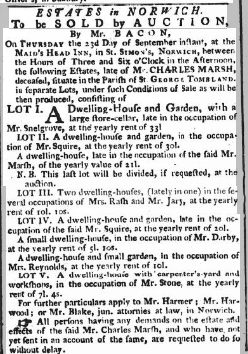
Possible that Edward Squire bought the dwelling houses he was occupying and maybe others including 24-6 Princes Street. Is a freeholder in St George Tombland from at least 1794
1800 Robert Marsh is a freeholder in St George Tombland. Robert Marsh II (1741-1822) was grand nephew of Robert Marsh I and continued the carrier business in Tombland along with his father, Isaac Marsh (1716-1757). Isaac Marsh was the younger son of Charles Marsh I.
1804 Edward Squire’s firm Squire & Hills open a foreign spirits warehouse and wine vaults at 11 Queen Street
1806 August – “On Tuesday last, Mr William [sic] Murrell of the Horse and Groom Inn, St George’s Tombland, to Miss Beane, of the same parish” marriage
1817 – A release and covenant dating from 2nd January 1817 records that Gibbs Leeds (presumably III) paid £250[1] to the Harvey brothers (Robert, John and Charles Harvey[2]) to buy the messuage or dwelling house and shop in St George Tombland in the occupation of Leeds, bounded by premises of Hewett Rand (north – Samson and Hercules court), premises of John Sayer Reeve, Rizen Mollett and Elizabeth Aylmer (east), Kings Highway (south) and a messuage called Princes Inn (west). See 1837 sale of what is definitely 22, formerly owned by Gibbs Leeds. So it could be that John Sayer Reeve had premises in 24-26 and 1 Tombland Alley, Rizen Mollett was in the old Augustine Steward House, and Elizabeth Aylmer was in 2 Tombland Alley. Rizen Mollett was a range and stove manufacturer and ironmonger and his shop premises at this point were on Tombland itself – probably the front part of the Augustine Steward house. John Sayer Reeve was a baker with a shop on Coslany Street in St Mary Coslany so perhaps he had further premises at 24-26 Princes Street. Who actually owned 24-26 is not clear – it could be Edward Squire as he was also a corn merchant, and part of an association of corn merchants, brewers and millers.
1819 Edward Squire dies. His freehold family residence in St George Tombland is put up for sale.
1819-1824 great rebuilding boom
1822 Thomas Buttifant, cabinet maker, is a tenant on Princes Street – possibly 24-26 or 22-26.
1827 “a freehold dwelling house, lately occupied by Mr Buttifant, and his under-tenants, with a stable and yard adjoining, situate in St George of Tombland, Norwich, fronting Prince’s Street and lying next the Church Alley” for sale
1841 census – Samuel Love, a plumber and glazier born in 1795 in St Saviours Norwich, with his wife Sarah and daughter Charlotte (b 1818) who was a milliner. His other daughters Mary (b 1826) and Sarah (b 1831) and son Valentine (b 14th February 1838) were also living with them.
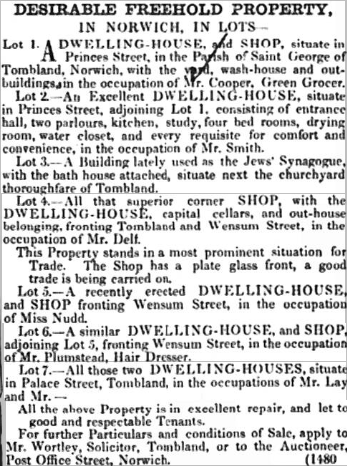
1851 24 Princes Street (occupation of Cooper) up for sale
1851 census – James Cooper b 1808 in St George Colegate, Norwich, operative stone mason. With his wife Mary Ann nee Browne, b 1808, greengrocer. Children: William (b 1835) stone mason’s apprentice, Ellen, b 1840 scholar, Charlotte Meary visitor, 5, scholar, Maria Larkman, lodger, silk filler, Emma Johnson visitor, 11.
1854 J.T. Furse cabinet and chair maker, upholsterer and paper hanger, announces move to Princes Street from Middle Street, St George’s
1856 James Furse, upholsterer and cabinet maker is in Princes Street
1861 census: James Thomas Furse (b 1824), upholsterer, employing 2 men and 1 boy. Wife Elizabeth nee Harrison, b 1824, son William b 1856, scholar, Ellen nice b 1851 in London. Keziah Thompson, servant.
By 1869 James Furse had moved out of 24 and was on Queen St, employing 6 men.
1870 electoral register – Fidelis Joseph Spaul (house) on Princes Street
1871 census: Fidelis Spaul, (b 1835), builder’s clerk. Wife Anne nee Smith b 1833. Daughter Frances A b 1857. Had been living in Ringers Court, Tombland. Other residents: Elizabeth Prath, lodger, Fanny Newman, lodger, Mary Prath, lodger. All draper’s assistants.
1873 Joseph Fidelis Spaull on register of electors as occupying a house on Prince’s Street
1876 Reginald Daines Brett at 24 Princes Street
1880 Register of electors for Princes Street – Frederick Cogman (house), George James Havers (house), John Grimwood Lacey (house), Fidelis Spaul (house), Reginald Daynes Brett (house and shop), Robert Thorndick Dawson (house)*M. Robert Cremer living on Magdalen St, qualifying property in Princes Street. Sarah Hewing is “citizen” as is
1881 Fidelis J Spaul, builder’s clerk, with Anne his wife, Frances M Smith b 1837 unmarried, sister in law, annuitant. But seems to be sharing #24 as two households, with Reginald D. Brett, greengrocer and his wife Elizabeth.
1882 Register of electors for Princes Street – Frederick Cogman (house) Fidelis Spaul (house), Reginald Daynes Brett (house and shop), Robert Thorndick Dawson (house). Robert Cremer living on Magdalen St, qualifying property in Princes Street
1883 Fidelis Spaul in Whites Directory on Princes Street, builder’s clerk
1885 Fidelis Spaul living at 2 Tombland
1887 register of electors – Brett at 33 Prince’s Street, having a house and a shop.
1888 directory – Fidelis Spaul, clerk, living between St George’s Church Alley and Reginald D Brett
1891
33 Princes Street – Reginald D Brett, Head, 42, wife Elizabeth and separate household, same number 33, Robert R Cremer and his daughter Harriet.
1891 Tillett says “embracing residence of RR Cremer Esq and Mr R Brett which were evidently formerly one house”
1901
24 Princes St (26 has “Graeme” recorded instead of number)
Robert Saunders Thorne boot maker, own account, at home, b 1861 Ber Street, St Julian Norwich of George Reuben (shoemaker) and Elizabeth Thorne d 1922. 1871+1881 living in Sherbourne Place St Ethledred Norwich. Wife Ann Jermy m 1886 b 1862. Daughter Ann Margaret born 1888, Herbert William born 1890, Laura Elizabeth born 1892, Hilda Grace born 1899, Reginald Victor born 1901, Harriet sister 33 boot machinist, Elizabeth sister 36 starch??. 1911 are living at 25 Cowgate Street, Ann, Annie Margaret boot machinist, Herbert hair dresser, married, Laura tailorer, Hilda schools, Reginald schools, George Reuben b 1903, Herbert Leonard grandson b 1911
1904
27th July auction of the double fronted shop with rooms over being 24 Prince’s Street near St George’s Tombland Church Alley let to the County Council for the Office of Weights and Measures, at a rent of £18 per annum, also in the rear a large building used as a parish room at a rent of £4 per annum
1911
Offices county council
1914 Jarrold’s Directory – 24 Weights & Measures
1921 Census – estate agency run by Frederick Crowe
1924-9
Frederick B Crowe antique furniture dealer
1931 no entry
1933-5 – restoration by Cedric Upcher. Plaster removed from front to expose brickwork and beams
Cornhill House, Cornhill Insurance Co Ltd, George W Milbank branch manager
1935 Cornhill Insurance – Geoffrey W Carter branch manager
1939 register – Cornhill Insurance
1941-7 Cornhill Insurance
1952 Carter, the builder, reports to Cornhill Insurance re 24 Princes street that there will be trouble with tiles slipping off from the house to the West and North occupied by Miss Hamshaw (22) and also from the synagogue to the North. Tiles may injure employees in the yard and the lavatories in the yard.
1954 oak doors, panelling, beams etc inserted in 24 Princes St in 1931 have become dirty, so renovated. Outdoor toilets also renovated
1955 Leaded lights replaced at number 24.
1955 Cornhill Insurance commission architect Cecil Upcher to restore 26 Princes Street and merge it with 24 Princes Street again.
1962 Cornhill Insurance move to 100 Princes Street. National Provident Institution for Mutual Life Assurance moves into number 24 to 1979
1979 Planning permission granted to National Provident to extend 24-26 as a single storey to provide staff facilities (24 and 26 were combined again at some point between 1973-1979?)
2001 – 2003 24 and 26 Princes Street/1 Tombland Alley and 2 Tombland Alley were converted from offices back into three houses. The single storey extension behind 24 was turned into a two-storey extension.
 Friends of Princes Street