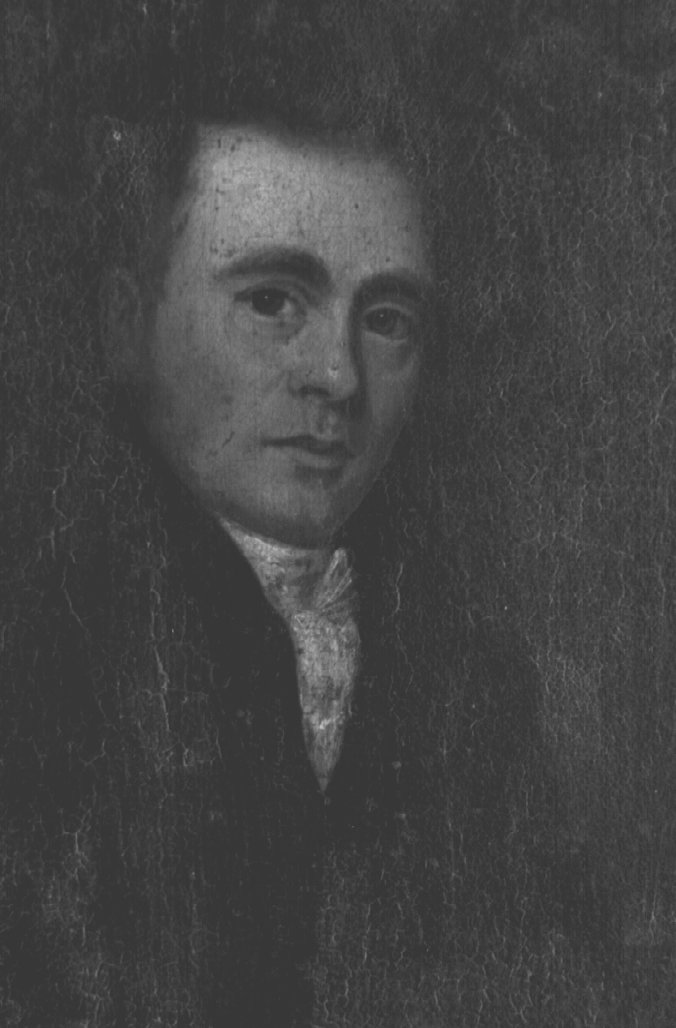
The 1837 electoral roll shows that both John Darken (1765-1863) and John Ninham (1775-1841, son of of John Ninham (1753-1817), founder member of Norwich School of painters and father of Mary Ann Ninham, married to Robert Mounsear II) were living on the St George Tombland end of Prince’s Street. It is likely this was on the south side of Princes Street, opposite 22-26.
The Darkens
John Darken was a Baptist, and a builder, had premises on Princes Street in St George Tombland, but in 1830 he dissolved his interest in a foundry business which had bankrupted in St Martin’s at Palace and then took his family to the United States in 1830. James Worman and Simon Stout of Princes Street announced that they took his business over.
The Darkens were intending to become inhabitants of the United States according to the passenger list for the Salem. They were heading to upstate New York, but ended up in Pennsylvania where John was commissioned to build a church. This was most likely St. Stephen’s Episcopal Church in Wilkes-Barre which had outgrown its initial 1823 wood-frame building. He was apparently cheated by the building committee and the church collapsed during the spring rains. (From NeilASCarver on Ancestry.com) Darken returned to Britain after his wife Frances died in Pennsylvania in 1831.
He placed a notice in the Norfolk Chronicle in September 1832 to contradict a malicious report that he voted at the election for Sheriff. “I did not vote at all yesterday, nor did I tender my vote, neither did I intend to do so, not having resided in my native city a sufficient time since my return to England, to entitle me to vote.”[1]
His eldest son, Edward John Darken, stayed on in the United States, graduating from Yale university and becoming Assistant Secretary to the Council of the House of Representatives, Iowa in 1842.
John Darken remarried in 1833 to Elizabeth Deynes, the older sister of his late wife. By 1834 he was advertising his business on Princes Street, offering the construction of horticultural buildings with heating by water.
The Ninhams
The Ninhams were originally a French Huguenot family who had fled religious persecution in the late 16th century.
John Ninham (1775-1841), was the brother of the Norwich School painter Henry Ninham. Their father was John Ninham (1754-1817), also a painter. John Ninham junior was a painter, plumber and glazier, had occupied premises and may also have been living on Princes Street in St George Tombland since at least 1822. He was in a partnership with his son John Michael Ninham, an “imitative painter”.

He may well have bought a Princes Street property in June 1834, when there was an auction of “all that dwelling house with appurtenances and carpenter’s work rooms and convenient yard, opening into Princes-street, in the parish of St George Tombland, now in the occupation of Mr Darken, builder, and all that dwelling house adjoining the last lot, with appurtenances, pleasantly situated next Princes’ Street, now unoccupied. Late in the occupation of Mr William Allen, stone mason.”[2] Presumably Darken had continued to occupy the work rooms and Ninham had moved into the dwelling house.
John Ninham senior’s wife Ann died in 1835 and was buried at St George Tombland. A notice was placed in the Norfolk Chronicle “in the 60th year of her age, after severe illness, which she bore with Christian fortitude and pious resignation to the will of her Divine maker, Ann, the beloved wife of Mr John Ninham, plumber and glazier, Tombland.”
Less than six months after his wife’s death, John Ninham, by then 60, married a Devonian woman, Harriot Joslin, who was 35 years younger than him. John and Harriet had a son, William Henry Thomas Joslin Ninham, the next year, and then a daughter, Harriet Joslin Ninham, in 1838, who died within a few months of birth, as did their second son Robert Ninham, who was born at the end of 1839. All of the children were baptized at St George Tombland.
Bankruptcies
In 1837 Ninham was declared bankrupt, with John Darken as one of the trustees. Ninham’s dwelling house, workshops and yards in St George Tombland were put up for auction in February 1837.
Darken moved his premises from Princes Street to Magdalen Street in October 1837 and the Princes Street premises were taken over by another builder, A.T. Tillett.
In December 1837 Darken was also declared bankrupt. In 1838 his residence in St Martin at Palace was put up for auction.
John Ninham senior died in May 1841, at the age of 66, and was buried at St Giles, his former parish. Harriot announced in the Norwich Mercury that she intended to carry on the business, via John Green, the foreman to her husband. She was living in Princes Street with her son William at the time of the 1841 census, possibly in the property whose freehold had been put up for auction. If so, then the likely route of the 1841 census taker suggests this property was on the south side of Princes Street, opposite 22-26. She appeared in the 1845 in White’s History, Gazetteer and Directory under her own name, at Princes Street, in the list of plumbers, glaziers and painters. In 1850, she put the assets of the business up for sale, moved to London and remarried.
John Darken re-started his building business in 1842 as John Darken & Son, in Magdalen Street. He sold his premises in 1844, retired to Holt shortly after and died there in 1863 at the age of 77.
[1] Norfolk Chronicle, 1 September 1832 p 2
[2] Norwich Mercury, 28th June 1834 p 1
 Friends of Princes Street
Leave a comment