
Augustine Steward, three times mayor of Norwich and Miles Spencer, five times Chancellor of the diocese of Norwich were to the shape the messuages around St George Tombland for centuries to come, in their property dealings surrounding the dissolution of the monasteries.
The Le Bruns
Until the dissolution, the advowson of St George Tombland church belonged to the College of St Mary in the Fields.
The advowson had been given to the college in the 13th century by the priest John Le Brun, the founder of the hospital of the Blessed Virgin Mary and the Chapel in the Fields. The remains of the chapel and college buildings can be seen in the current day Assembly Rooms.
The advowson of St George Tombland included “three messuages…and their gardens and orchards” (Blomefield), probably the land and buildings surrounding the church in what is now Tombland Alley, Princes Street, Tombland and Waggon and Horses Lane. It may have been that the hall type building now at the back of 26 Princes Street was the rectory of St George Tombland.
John’s brother Jeffrey, rector of St Andrew, gave the advowson of St Andrew’s to the college, as did his brother Matthew the advowson of St Mary Unbrent (which would have been on present day Magdalen Street). The three brothers had probably inherited the advowsons from their father.
The name Le Brun suggests Norman origins, although the area of Tombland continued to be a centre for Anglo-Saxons after the Normans moved the market and settled more around what is now the Guildhall area and St Peter Parmentergate.
The college of St Mary in the Fields became a counterbalance to the Cathedral, receiving civic funds, bequests and support from the city. John Le Brun was even thought to have been involved in the riots of 1272 in Tombland, against the Cathedral, when lighted arrows were fired from the tower of St George Tombland.
Augustine Steward
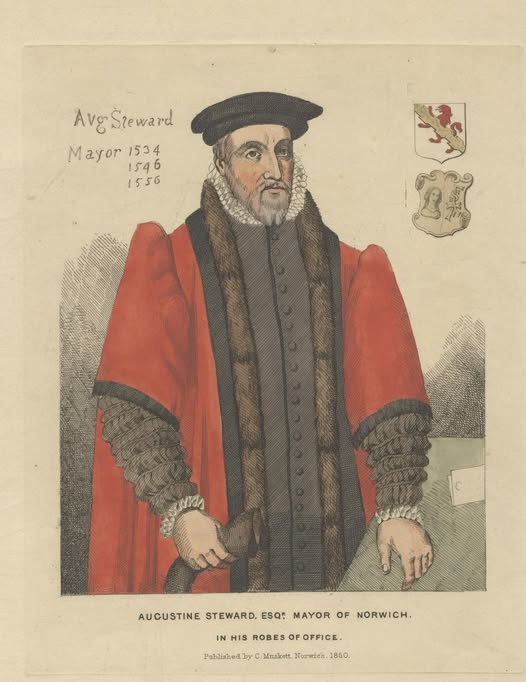
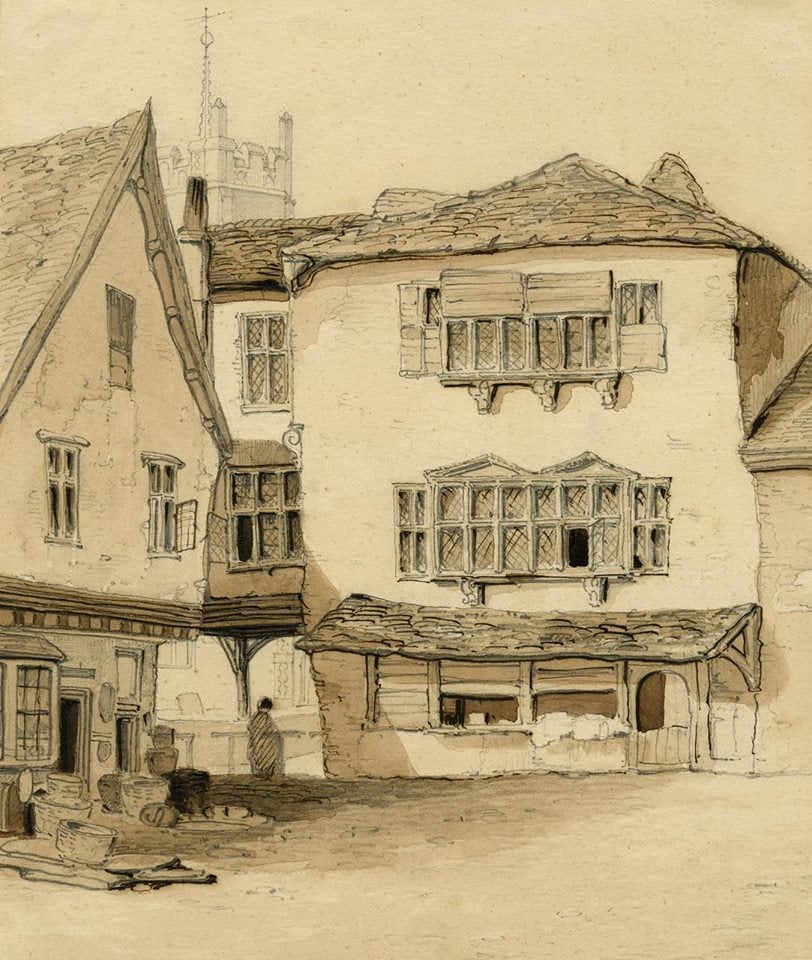
By the time of the dissolution of the monasteries began in 1536, the Dean of the College of St Mary in the Fields was Miles Spencer (1480 – 1569). The college had come to be used as a meeting place for the city corporation and assemblies of Norwich’s freemen, aldermen, sheriffs and mayors.
Augustine Steward was one such alderman, born of Geoffrey Steward and Cecile, nee Boyce/Boys, in St George Tombland in 1491- probably in the predecessor of what is now called Augustine Steward’s house.
Augustine’s father Geoffrey was an alderman too, and a mercer. Augustine became his apprentice, presumably in his early teens, before Geoffrey died in 1504, and was admitted as a freeman of Norwich in 1516.
After Geoffrey’s death, Augustine’s mother Cecily married John Clarke, a merchant and grocer and later mayor, and continued as a merchant herself, with her own merchant’s mark. Cecily’s father, Augustine Boys or Boyce, is thought to be the reason for Augustine Steward’s given name, and possibly some of the family fortune.
Augustine Steward added to the fortune as a merchant and by the time of the dissolution was wealthy enough to buy up the Blackfriar’s monastery (now St Andrew’s Halls) and the messuages around St George Tombland, adding to the various manors he had already acquired around Norfolk.
Steward had already been negotiating with the King to review the settlement made by Cardinal Wolsey in 1524 between the Cathedral Priory and the city corporation when he was first mayor in 1534. In 1539 the king found in the city’s favour, and in 1540 Augustine Steward bought Blackfriars monastery, for the city, for £81, with his own money.
Miles Spencer
At around the same time that Augustine Steward was buying Blackfriars, Miles Spencer, the dean of the college of St Mary in the Fields, negotiated a deal with the king whereby the college members resigned for small pensions, the chapel and college were surrendered to the crown and the chapel and cloister destroyed.
The remaining buildings and other properties, including the manor of Bowthorpe, were then granted to Miles Spencer, after which he used one of the buildings in St Mary in the Fields as his private residence. Blomefield described Spencer as having not only alienated (sold) the revenues of the college, but that he “swallowed up” the revenues for himself by obtaining a grant of it and many other things as an annuity of £4 and 17s from the priory. This is only £2,000 or so in present day value, so he would clearly have been wanting to add to it with other property dealings.
Spencer sold St Mary in the Marsh (the church within the Cathedral precincts) to Dr Gascoigne, which was then pulled down. He also sold at least one of the St George Tombland messuages, current day 22-26 Princes Street, to John and Elizabeth Clarke, nee Clarke. John Clarke is described as a cook, and was possibly related to John Clarke, the merchant who married Cecily Boyce, Geoffrey’s Steward’s widow, the mother of Augustine Steward.
Up until 1538 or so, Augustine Steward had been renting the Princes Inn messuage from Miles Spencer. He petitioned the Norwich Assembly in that year for reduction of rent on the estate because it was a ” voide and decayed grounde… called the Prince Inn off the graunt of the Deane off the Chapell in the Feldes in Norwich ffor the terme off an hundred year, which voide grounde is soore accombred and replenysshed by divers persons with muk and such other vile mater to the grette noysaunce of all the Kynges liege people passing by the same by reason that itt hath ben open and nat ffensed by many yeres”.
It seems likely that shortly after that, Spencer gained the grant of the buildings and messuages that had belonged to the college, from the king, and then sold Princes Inn and the other St George Tombland messuages to Augustine Steward and his family.
The great rebuilding of Norwich and other cities in England began around 1550 and it seems likely that either Augustine or his son William rebuilt what is now 22-26 Princes Street and 20/Princes Inn, large parts of which had been in ruins since the fire of 1508. Steward also rebuilt Paston House in Elm Hill around this time.
Kett’s Rebellion 1549
By 1549 Augustine Steward was living in the house he was born in, probably rebuilt and refurbished, facing onto Tombland, opposite Erpingham Gate and the Cathedral and next to St George Tombland and the church alley.
In July 1549 Robert Kett and his rebels made their first camp on their march from Wymondham to Norwich at Bowthorpe manor – belonging to Miles Spencer. It was land that had been enclosed, and was uninhabited except for thousands of sheep – the very thing that Kett and his followers were rebelling against. The church had been used as storage and it seems the hall itself was unoccupied, as Kett used it for his headquarters.
Once they entered Norwich, Kett’s men captured the then mayor, Thomas Codde. Codde had actually signed the petition of grievances organised by Kett, but urged the rebels to moderation and denied them passage to the city, apparently saying “I will give the blood and life out of my body before I will by villainy treacherously forsake the city, or through fear or cowardice wickedly cast off my allegiance to my king.”
Codde appointed Augustine Steward as his deputy, who presented the city’s sword to the Marquess of Northampton and his troops, and invited the Marquess to dinner at his house on Tombland. However the Marquess quickly withdrew from the city when the rebels entered. They forced their way into Steward’s house ‘took him, plucked his gown beside his back, called him traitor and threatened to kill him’ and then ransacked his home.
The rebels sent Steward and Robert Rugge to negotiate on their behalf with the Earl of Warwick, who was also approaching the city with his troops. However, Steward and Rugge informed Warwick of how to retake the city instead.
Despite his capitulation to the king’s men, Steward retained his standing in Norwich after the rebellion, becoming mayor again, in 1556.
Miles Spencer and the Marian Persecutions
Norwich remained quiet for some months after Queen Mary’s heresy statute went into effect in January 1555, but Miles Spencer and Dr John Fuller, the Vicar General and the Official Principal to Bishop Hopton, moved with “celerity and speed” to deprive English clergymen who had taken wives after the March 1554 injunctions.
Miles Spencer, who is thought to have been “traditional” in his religious views, was co-chancellor of the Norwich diocese with Michael Dunning. Dunning was termed the “Bloody Chancellor” by John Foxe and seen as responsible for the burning of 31 heretics, although few of them took place in Norwich.
It may have been that Spencer used his position as co-chancellor to restrain Dunning’s activities in Norwich itself. After many years as Dean of the secular college of St Mary in the Fields, Spencer was friends with and had relatives among the gentry and freemen of Norwich.
Nonetheless, by spring 1555, thirteen priests who had served at Norwich Cathedral or in city parishes had been forcibly divorced from their wives and deprived of their livings.
Dunning died in 1558, the year that Elizabeth I succeded to the throne and Miles Spencer became Canon of Norwich – another indicator that he had not been too openly on the Catholic side of the Marian persecutions.
Settlement and rebuilding
The rebuilding of 22-26 Princes Street must have happened by 1565,when John and Elizabeth Clerke/Clarke granted to Augustine Steward the tenement and garden they had bought from Miles Spencer. This was described as being between the tenement of John Clerk to the east, a tenement of Augustine Steward to the West and a garden of Augustine Steward to the north, and a highway to the south (which would now be Princes Street). This suggests that the tenement they had bought from Spencer and then sold to Steward was 22 and/or 24 and that they continued to live at 24 and or 26 Princes Street, and/or perhaps what is now 1 Tombland Alley, the old rectory.
Augustine Steward passed on the Princes Inn messuage by the time of the Landgable Rental of 1568-1570 (a tax record) to his son William, who was a clergyman and alderman. The neighbouring tenement is recorded as being owned by Augustine Sotherton, a grandson of Augustine Steward.
Legacies
Augustine Steward died in 1571, at the age of 80, having ensured the prosperity and continuation of his family and of Norwich, with his property dealings and development, and through the good marriages of his many children. He asked to be buried in St Peter Hungate on the west end of Princes Street/Hungate, where his wives had been buried.
Miles Spencer continued to hold positions in the Norwich Diocese several times from 1537 onwards, until his death in 1569, at the ripe old age of 89.
According to Blomefield, quoting Thomas Browne’s Repertorium of 1680, Spencer was buried in the Cathedral, “between the 5th and 7th south pillars, and over his grave was an altar tomb, covered with a sort of touch-stone, which is robbed of its brasses and much split, but was formerly taken notice of, because people used to try their money upon it, and the chapter demanded certain rents to be paid on it.”
Spencer had “died single” and left the manor of Brandon and all land, tenements and other hereditaments to his nephew Robert Constable. He also asked that Constable ensure Spencer’s sister Jane had an annual income.
Other beneficiaries of his will were the Yaxleys and the Cornwallises, both leading Catholic families. The Yaxleys became the owners of Bowthorpe Hall, the property of Miles Spencer that had been occupied by Kett’s men, shortly after.
Another indication of Spencer’s wish to keep an ecumenical and civic peace in Norwich was that he also left money to Richard Fletcher (-1570), described as a “friend” in his will. Fletcher was an alderman, sheriff and mayor who in his own will of a year later left money to George Leeds, a Puritan curate of St Stephen who was suspended for nonconformity in 1576.
Sources
The Mayors of Norwich 1403 – 1835- Cozens Hardy and Kent
A History of Norwich – Frank Meeres
A History of 20 Princes Street – Geoffrey Kelly
The Visitation of Norfolk 1563
https://www.historyofparliamentonline.org/volume/1509-1558/member/steward-augustine-1491-1571
A Topographical History of Norfolk – Francis Blomefield, volumes 3 and 4
The Quiet Reformation: Magistrates and the Emergence of Protestantism in Tudor Norwich – Muriel C McClendon, Stanford University Press, 1999
 Friends of Princes Street
Leave a comment