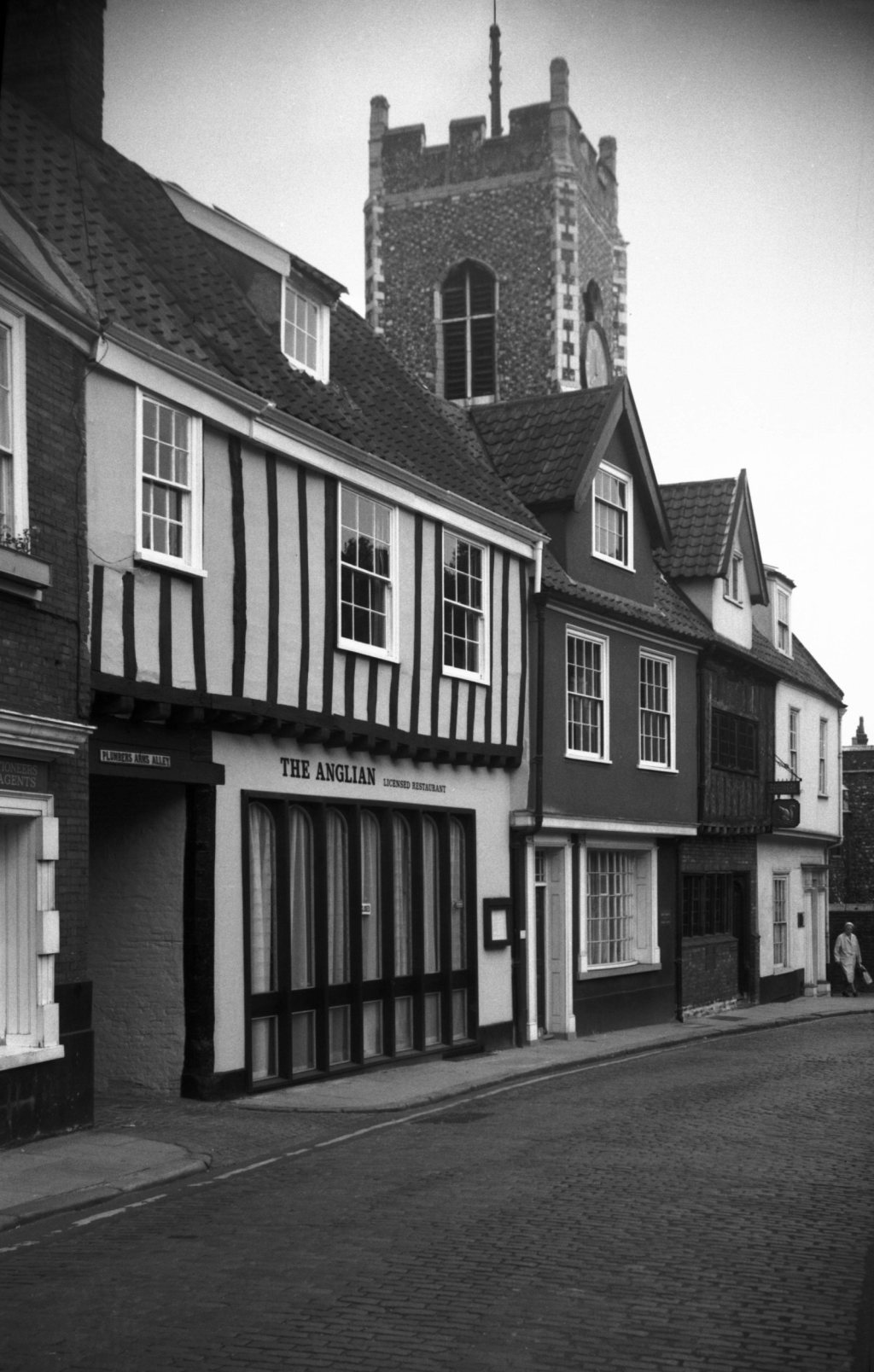
20 Princes Street, now the Trattoria Rustica, was the Princes Inn from the 14th century to 1816, when it became the Plumbers Arms.
1320-5 Princes Inn owned by Mabel Gotte, widow of William Gotte.
1323 Common lane running between Hungate and Waggon and Horses Lane (now Plumbers’ Arms Alley).
In 1324, Mabel conveyed Princes Inn to one William de Camel de Skeyton, whereupon the latter granted it to her for term of her life. However, in 1325 Mabel conveyed it to Robert de Fornesete, a baker. In 1330, Robert conveyed it to John de Wicklewode.
On 9th September 1373, a licence was granted to the Dean and Chapter of the College of the Blessed Mary in the Fields to shut up the common lane (Plumbers’ Arms Alley) with two gates.
1391 first mention of Princes Inn according to Beecheno
1397 Norwich Domesday Book – Dean of the College of the Blessed Mary in the Fields was to pay the Treasurer of the Community of Norwich twopence for the tenement ‘late the Princesin’
The Norwich Treasurers’ roll for 1412/3 recorded the payment of 5s 4d to William King and John Preston for wine sent to Simon de Felbrygg, John Wynter and others when they were ‘supping at the Princes Inn’. It further noted the payment of 11s 11d for divers expenses at divers times at ‘Dowes’ [location unknown] and ‘The Princys Inn’ .
After 18th February 1415, Norwich Corporation granted the common lane – now Plumbers’ Arms Alley – to Ralph Gunton, clerk, notary public; it then had his tenement to the west and ‘le Prince Inne’ to the east. In this grant, it was stated that the common way was open but incumbered with dunghills to the great nuisance of the neighbours, moreover it had not served as a common passage for a long time. It would be for the benefit of the city if it were enclosed because of the lying in wait there of malefactors in the night season. Gunton was to pay one penny annually for the privilege of enclosing this way, and was to maintain a door at each end of it which was to be opened only in time of necessity such as a fire or for the purpose of repairing the adjacent properties
1456 Paston Letters mention Princes Inn – John Bokkyng, Sir John Fastolf’s clerk, wrote from Caister Castle to John Paston: ‘Your cofre is at the Prinse Inn’
1496 Waggon and Horses Lane known as Prynce Innelane – continued to be known as this until 1708
Princes Inn would have been damaged by the fires in Norwich 1507-8 – the undercroft from the 14th century survived however.
1535 The void grounds declared at the Convocation of Aldermen then included the ‘Prynces Inne’
1538 Augustine Steward asks for reduction of rent on Princes Inn estate because it is a void messuage.
1541-1547 Princes Inn continues to be referred to as a void messuage
1568-1570 landgable records show Augustine Steward has passed on Princes Inn messuage to son William (1527/30 – 1610) – clergyman and alderman. Neighbouring tenement (22?) owned by Augustine Sotherton (bef 1553-1585), grandson of Augustine Steward.
1596 Norwich Assembly – recorded that Richard Hall, cook, was to have “a certain late waste ground, now re-edified, called Prynce Inn” which had been purchased by the City of Norwich
1606 to 1626 Landgable Rental records Princes In as owned by Lady Barney/Berney, known as Dame Julian. Thomas Styward, son of William Styward, grandson of Augustine Steward/Styward had sold Gowthorpe Manor to Dame Julian in 1628. She was the widow of Sir Thomas Barney of Reedham, a sheriff of Norfolk, who had died in 1616.
1620 a Robert Hall, also a cook, the son and heir of Roger Halle of Norwich, cook, sold a tenement to Richard Harman of Norwich, a skinner, situated between the Clarkes to the East, Charles Powle to the West, William Browne to the north (Augustine Steward’s house), on Princes Street.
1665. Robert Scarfe, woolcomber, and Lydia his wife, on 20th Dec., 1665, sold to William Tuke; of Norwich, worsted weaver, tenement sometime of Robert Hall, afterward of Richard Harman, late of James Scarfe and Mary Scarfe (daughter of Richard Harman), between messuages of Charles Cowell W., – Clarke E., William Brown, Esq., dec. N., King’s highway S.
1665. William Tuke;, worsted weaver, and Elizabeth his wife, on 23rd Dec., 1665, sold to William Mendham of Norwich, bodismaker, a messuage sometime of Robert Hall, late bought of Robert Scarfe, and now occupied by Thomas Lacey
1668 William Mendham of Norwich, bodismaker, and Olive his wife, on 19th Dec., 1668, sold to Joseph Larwood;, cordwainer, and Martha his wife, a tenement sometime of Robert Hall, late bought of William Tuke.
1672 John Dawson; of Framlingham, Suffolk, Gent., and Sarah his wife, only daughter of John Gostlin of Bawburgh, Gent., dec., and Thomas Mudyclift of New Buckenham, Gent., and Mary his wife, relict of said John Gostlin, on 22nd Mar., 1672,released to William Burgesse of Norwich, carpenter, a messuage called “Prince’s Inne,” now occupied by John Becroft and Joel Sargesson (son of Thomas Sargesson, who had been an apprentice to Roger Hall, cook, Princes Inn), or their undertenants, situate between a messuage sometime of Thomas Spendlove, Gent., and late of Roger Smith, Gent. W., a messuage now or late of Christopher Jay, Esq., in part, and a tenement now or late of Jacob Larwood; in part E., king’s highway S., lane called Prince’s Inn Lane N.
1686 Will of William Burgesse dated 31 October, 1686, he gives his wife Ann his tenements in Tombland, lately purchased of John Dawson; and Mary his wife, and of Tho. Muddicliffe and Mary his wife, occupied by Ralph Nicholas, Peter Delahay, clerk, Willm. Lintell, Wm. Clark, and Saml Partland;, for her life; and, after her death, to Peter Burgess, clerk, his kinsman.)
1689 William Burgess dies. Buried at St John Maddermarket. Wife Ann(e) inherits estate east of Princes Inn.
1701 Anne Burgess, widow of William Burgess, carpenter, who died in 1689, dies. The Princes Inn messuage was then passed on to William’s kinsman, Peter Burgess. Peter Burgess was a clergyman in Whinburgh.
1728 Peter Burgess dies. The executors of his will “paid the city for a messuage, called Prince’s Inn in Tombland, granted to Augustine Steward, 30th Henry VIII (1538); also for a tenement sometime Dr Capps’, now annexed to said Inn” He left his St George Tombland property to his son Robert Burgess, a woolcomber.
1763 – licence granted to John Wright, a labourer, for Princes Inn
1774 John Ollyett, tailor, named in respect of the Princes Inn alehouse in the Poor Rate book. John Ollyett marries widow of Robert Woodhouse.
1789 – John Howes becomes owner of Princes Inn messuage – coach master, who used to run the Norwich and Yarmouth machines.
1798 Land Tax Redemption – Arthur Ladell, the Princes Inn licensee from 1798 to 1808, the occupier of a dwelling owned by John Howes in St George Tombland.
1799 will of John Howes, leaves all real estate now lived in and adjoining, in occupation of Mrs Harrison and Messrs Ladle (probably Arthur Ladell, licensee for Princes Inn) and Larke (probably Edward Lark, licensee for Coopers’ Inn), to his son, John Howes and all goods and chattels to wife Mary. Witnessed by Ziba Bolton, Robert Cooper, John Hannar.
1809-1810 John Hague, publican, Princes Inn
1811-1814 Benjamin Clark, publican, Princes Inn
1812-3 Hungate Street renamed Princes Street
1816 – Princes Inn became Plumbers’ Arms. Thomas Dawson was the licensee of the Plumbers’ Arms until 1819, followed by his widow Margaret from 1820 to 1827
1823 owner of Plumbers’ Arms is John Morse, through to 1832. He owned a brewery and 21 other public houses.
1828-9 Hooper is licensee of Plumbers’ Arms
1829 John Howes will of 1799 administered. Had not been administered by Mary Howes, then on her death, will granted to Elizabeth Howes, widow of John Howes junior.
1831 John Morse’s son George amalgamates brewery and public houses with Steward, Patteson & Steward
1836 Reuben Widdows, Plumber’s Arms
1837 Steward, Patteson & Steward merged with Finch’s brewery, becoming Steward, Patteson, Finch & Co. Retained ownership of Plumbers’ Arms until 1870s
1840 Charles Chaplin is licensee for Plumbers’ Arms
1841 census 20 Charles Chaplin, 38, Publican, Maria Chaplin, 25, Maria Love female servant 18
1845 William Middleton licensee for Plumbers’ Arms
1846 Joseph Hewing is licensee for Plumbers’ Arms – for the full colourful story of his tenure, see our blog post The Plumbers’ Arms and the temperance movement
1851 census Joseph Hewing, Innkeeper, 41, Jane, wife, 35. Ellis Garrach, visitor, 23, HM 98th Regt Foot. William Yaxley, 36, HM 52nd Regt Foot, George Coleman, 29, HM 9th Regt Foot. Elizabeth Hales, 23, dressmaker, Hannah Catchpole, 20, shoebinder, Elizabeth Hunt, 23, dressmaker, Elizabeth Hunt, 3.
1861 census John Hewing, 50, publican, Sarah, wife, 35, Looey Worton, lodger, 49, agricultural labourer
1871 census Joseph Hewing, 60, publican, Sarah Hewing, 44
1871/2 Joseph Hewing buys Plumbers Arms from Steward, Patteson, Finch & Co
1872 Joseph Hewing is in the poll book as an owner and occupier
1877 Joseph Hewing dies
1881 census – Sarah Hewing, widow, 59, publican, Robert Wigg, nephew, 27, moulder, Sarah Wigg, niece, 29, Alice Hayes, 19, dressmaker, Ellen Grand, servant, 17
1881 July – Sarah Hewing charged with keeping a brothel at the Plumbers’ Arms. Plumbers’ Arms is delicensed.
1889 Reuben Levine, second-hand bookseller and dealer in antiquities, in 1890 as a dealer in antiquities, and in 1892 as a furniture dealer
1891 census – 29 Princes Street (20 to be) Rebecca Levine, living on own means, widow, 58. Reuben, son, 24, dealer in antiquities, Minnie, daughter, 22, Amelia, daughter, 19
1892 directory – 29 Princes Street Furniture Broker and dealer
1895 William Claxton of Princes Street in the magistrates court for using obscene language
1901 census – William Henry Claxton 57, own account at home, occupation chiropodist, wife Lucy 58
1904 Albert Turner coach builder at 20 Princes Street and 25 Palace Street
1910 Albert Turner owns 20 Princes Street
1911 census – Albert Turner, 52, coach painter/employer, wife Lettice, Bernard, son, 14, grand daughter.
1921 census – Albert Turner (60), coach builder on own account and wife Lettice (64) at 20 Princes Street with son Bernard, 24, out of work engineer, 2 boarders and 2 year old nephew.
1931 February – Albert Turner dies aged 70
1931 December – Lettice, Albert Turner’s wife dies in the Workhouse, aged 75
1933 20 Princes Street – Albert Wigby Turner (b 1888, son of Albert Turner), furniture broker and dealer
1939 register – 20 Princes Street – Albert Wigby Turner, antique dealer, own account, Beatrice Steward, b 1887. Antiques shop.
1954 Albert Ashton Turner shuts down antiques shop at number 20.
1961 Bernard Ashton Turner dies
1964 number 20 is Anglian Grill – owners Alfred and Rose Dennis
1965 Albert Wigby Turner dies.
1965-6 Alfred and Rose Dennis
1967 Kenneth and Lily Lee
1968 – 1978 Mark and Loretta Turner are license owners of The Anglian Restaurant
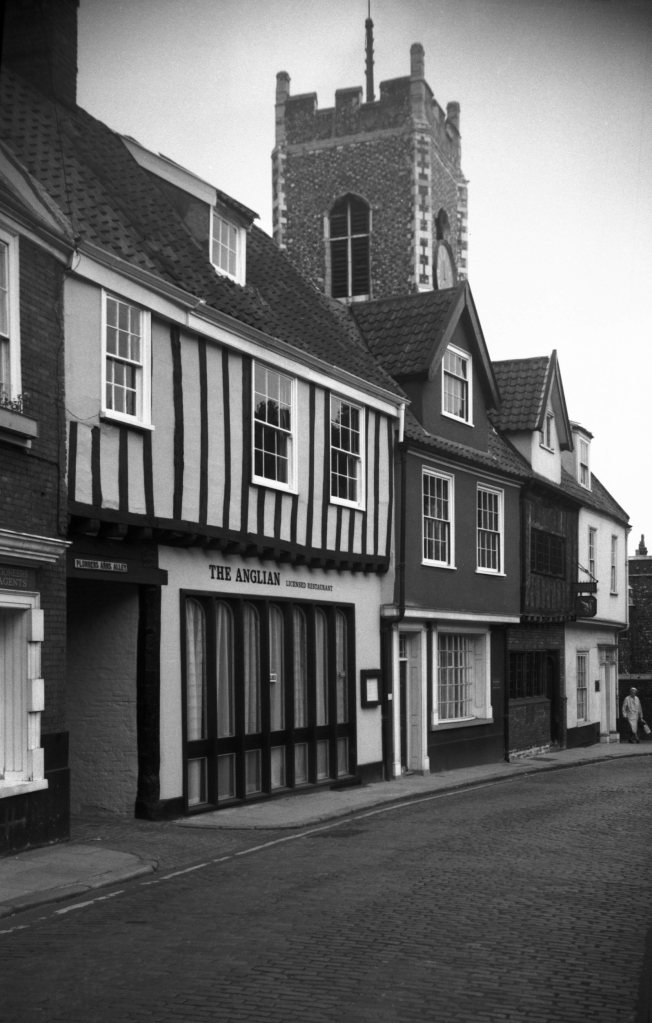
1980-1981 Roger and Jacqueline Hill
1994 Trattoria Rustica opens. See photos on the Trattoria Rustica website for the undercroft and a virtual tour.
 Friends of Princes Street