13th and 14th century connection to St Mary in the Fields
20 Princes Street – known as the Princes Inn, then the Plumbers’ Arms and now as the Trattoria Rustica is and was a separate building although now contiguous with 22-26 Princes Street, which was one building, now divided into three. These may have been tenements (separate residences) within one messuage (group of houses, outbuildings and gardens)or two separate messuages in the medieval period.
1272 – John Le Brun, a priest, gives the college of St Mary in the Fields (where the Assembly House now is) the advowson of St George at Monastery Gates (now St George Tombland) – possibly inherited from his father. It included 3 messuages – which may have included 20-26 Princes Street. The medieval hall style building at the back of 26 Princes Street, in Tombland Alley, could have been the rectory of St George. (p.378 History of Norfolk, Blomefield)
1397 Norwich Domesday Book – the Dean of the College of the Blessed Mary in the Fields was to pay the Treasurer of the Community of Norwich twopence for the tenement ‘late the Princesin’
16th century rebuilding and Augustine Steward
1545 the chapel and college of St Mary in the Fields were surrendered to the crown and the chapel and cloister destroyed. The remaining buildings were granted Dr Miles Spencer, who used the college as his private residence. The rest of the property included three messuages at St George’s and their gardens and orchards. (Blomefield). This may have been Princes Inn, 22-26 Princes Street/Tombland Alley and what became Augustine Steward’s House and the Samson & Hercules.
Miles Spencer seems to have sold two messuages to Augustine Steward (Princes Inn and Steward’s house/Samson and Hercules to Steward and 22-26 to John Clerk/Clarke, a cook and his wife Elizabeth nee Clarke. Augustine Steward commenced upon an extensive redevelopment of the whole Tombland/Princes Street area.
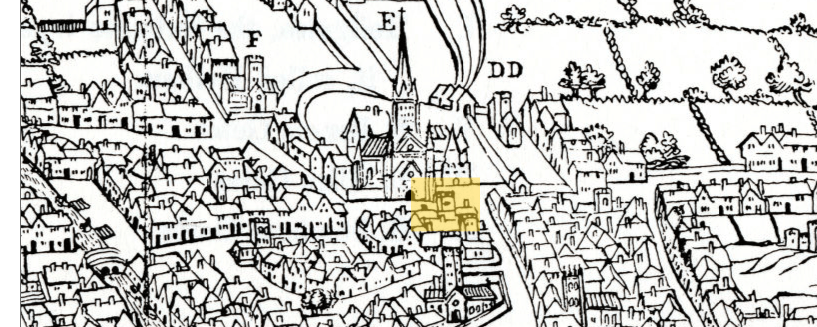
Above: Cunningham map of 1558. St George Tombland highlighted
The timeline for 22-26 Princes Street continues here
The timeline for 20 Princes Street/Princes Inn continues here
 Friends of Princes Street