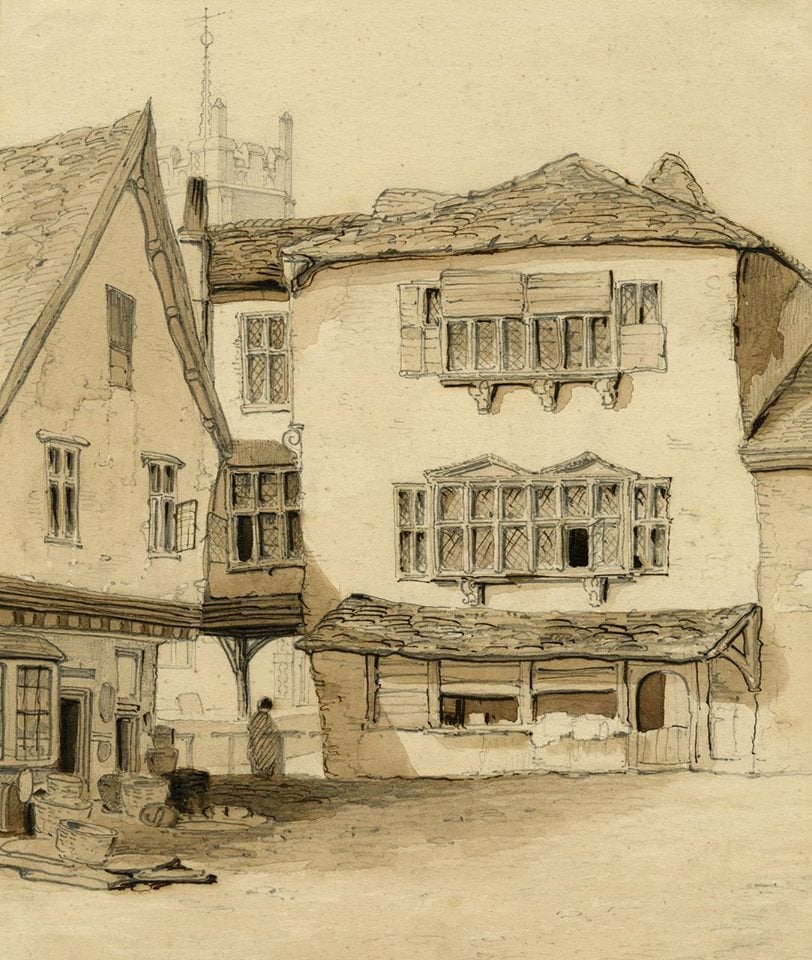
It was between 1812-1813 that Hungate Street was renamed Princes Street – perhaps to commemorate start of the Regency in 1811. St George Tombland was in the Wymer ward.
1800 – Elizabeth Aylmer owns 2 Tombland Alley. Mrs Howes, probably Mary, widow of John Howes senior, owns 20 Princes Street. Harveys owned 22 – 26?
1800 Land Tax Redemption
- Mrs Aylmer owner, Dennis Greenfield occupier
- Robert Harvey esq owner, Captain William Gordon occupier
- Mrs Howes owner, Arthur Ladell and [Ziba] Bolton occupier
- Robert Marsh owner (of two properties), Robert Marsh occupier (4 Tombland?)
1802 Election – candidates Robert Fellowes (Whig), William Smith (Radical) , William Windham (Whig), John Frere. Fellowes and Smith elected. St George Tombland freeholders: Thomas Blake (attorney at 5 Queen Street Fe W), Thomas Fabb, carpenter, (W Frere), Joseph Hipkins baker, (Fe S), John Howes gent (Fe S), William Cooch Pillans Esq, (W Frere), Rev Philip Stannard (Bethel St in 1811 (W)), Richard Stevens (W), weaver, Benjamin Sword, coachman (Licensed to Let Post Horses, Chaises, &c. 6, King street. 1802 Peck’s directory (Frere)). Not Freeholders – Gibbs Leeds sieve maker Fe S, Robert Marsh, carrier, Fe W. St George Tombland result: Fellowes 15, Smith 14, Windham 27, Frere 23
1802 Peck’s Directory https://www.gutenberg.org/files/44709/44709-h/44709-h.htm
Hungate Street
- 8 Mrs Brunton, baker
- 9 John Parkerson – House-Bell Hanger and Venetian Blind-Maker
- 13 John Ha[o]wes, coach maker (St George Tombland voter)
- 14 Ziba Bolton coach master
- 16 Thomas Smith, Tailor and Habit Maker
- 21 Capt Gordon
- 22 James Shickle, plasterer
- 26 Charles Martin, upholder
1803 England declares war on France, start of Napoleonic Wars
1806 Election. St George Tombland in Wymer ward. Candidates: John Patteson Tory (elected) Robert Fellowes Whig (elected), William Smith (Radical). Results in St George Tombland: Fellowes 18, Smith 15, Patteson 26.
Freeholders – Thomas Blake esq (FP), Thomas Fabb carpenter (P), Robert Gay (basket maker 15 Tombland in 1802 (SP)), Jeremiah Lorkin schoolmaster (P), Edward Squire (1 Tombland and King Street, corn merchant (P)), Richard Stevens worsted weaver (P), Thomas Wilson (confectioner on Queen St (SP)). Freeman – Gibbs Leeds (FS). Rising Mollett whitesmith (FP) Robert Marsh Esq (FS)
1806 Population of Norwich estimated at 36,000
1807 Election – candidates John Patteson (Tory), William Smith (Radical), Robert Fellowes (Whig). Patteson and Smith elected. St George Tombland result: Patteson 27, Smith 13, Fellowes 13
St George Tombland freeholders – Thomas Blake esq (PF), Thomas Fabb (P), Robert Gay basket maker ( PS), Jeremiah Lorkin school master (PF), Rising Mollett (Whitesmith on Pig Lane in 1802 (P)), Hewett Rand Esq (Samson & Hercules Court in 1802 (PF)). Freeman: Gibbs Leeds (S)
1811 Prince Regent (George IV)
Hungate Street:
- Henry Adcock, publican, Coopers
- John Baker, Boot and Shoemaker
- Robert Bond, surveyor of assessed taxes
- Mary Brunton, Baker
- Joseph Butler, shopkeeper
- John Butler, duffell maker
- Charles Fairhead, bricklayer
- William Green, lodging house
- Hague, publican, Princes Inn
- Charles Hodgson, young gentlemans’ academy
- Gibbs Leeds, sieve maker (St George Tombland voter)
- John Mendham, baker
- Robert Mounsear, upholder (St Peter Hungate voter 1812)
- J Parkerson, bell founder and blind manufacturer (St Peter Hungate)
- James Shickle, Plaisterer (St Peter Hungate voter 1812)
- Rob Taylor, publican, Jolly Dyers (16 Fishergate, St Martins at Palace Plain?)
- William Tillet, publican, White Lion (Chapel Alley, St Michael at Plea)
- John Walker, bricklayer and house-broker (St Peter Hungate voter)
- Thomas Walker, machine maker
- The Permit-office, in St. Peter’s Hungate, opposite the Church
1812 Election – candidates John Patteson (Tory), William Smith (Radical), Charles Harvey. Smith and Harvey elected. St George Tombland result Patteson 32 Smith 22 Harvey 31
Freeholders – Edward Barron Esq (S), Thomas Blake (barrister in Queen St) (PH), Thomas Fabb carpenter (P), William Foulger gent (Flour merchant in Trowse in 1802 PH), Samuel Gaze cordwainer (Three Compasses, 203, King-street in 1802) (PS), Jonathan Gaze shoe maker (S), John Kitson gent (PH), Jeremiah Lorkin school master (PH), John Nickalls patten maker (P), Edward Squire merchant (PH), George Warne (Musician, 1, Cook’s lane, King-street in 1802) (PH). Non-freeholders: Gibbs Leeds senior sieve maker and junior PH. Robert Marsh gent (SH), SC Marsh (Samuel Clark, nephew) (SH), Rising Mollett, smith, (S)
1812 Charity school set up on southwestern side of Princes Street in Aldred’s Court
1812 Auction of 6 properties in St Peter Hungate – Mr Hodgson, Mrs Slack, Gaze, Excise Office, Parkerson, Butler, Parkinson

1813 SEVEN or eight very excellent new freehold ESTATES, in the parish Saint Michael at Plea, Norwich, fit for the residence of small families. Also commodious HOUSE, St. Peter’s Hungate, comprising six-good rooms, and handsome vestibule. For further particulars apply to Mr. Nosworthy, Queen-street, Mr. Shickle, plaisterer,. No. 22, Princes-street
1813 Auction: at the Maid’s Head Inn, Norwich, at four o’clock in the afternoon, A FREEHOLD ESTATE, opposite the Prince’s Inn, St. George’s Tombland, Norwich, formerly in part the residence Mr. John Howes, coach-master (died around 1813), the following lots . Lot 1. Dwelling-house and Shop next the street, in the occupation of Mr. Baker, shoemaker. Lot 2.—-A Public-house called Coopers, the occupation of Grimson. Lot 3.—A Dwelling-house, with the Work-shops, Warehouses, Stables, Yards, and Premises, late in the occupation of Ziba Bolton, coach-master, and now of Thomas Walker, machine maker. And also a Dwelling-house adjoining, in the occupation of Mrs. Howes. This lot is a very desirable situation for a coach maker, stone-mason, carpenter, or any other trade, wanting work-rooms and yard room. Two-thirds the purchase money may remain on the premises.
1814-5 end of Napoleonic wars
1817 – A release and covenant dating from 2nd January 1817 records that Gibbs Leeds (presumably III) paid £250[1] to the Harvey brothers (Robert, John and Charles Harvey[2]) to buy the messuage or dwelling house and shop in St George Tombland in the occupation of Leeds, bounded by premises of Hewett Rand (north – Samson and Hercules court), premises of John Sayer Reeve, Rizen Mollett and Elizabeth Aylmer (east), Kings Highway (south) and a messuage called Princes Inn (west). See 1837 sale of what is definitely 22, formerly owned by Gibbs Leeds. So it could be that John Sayer Reeve had premises in 24-26 and 1 Tombland Alley, Rizen Mollett was in the old Augustine Steward House, and Elizabeth Aylmer was in 2 Tombland Alley. Rizen Mollett was a range and stove manufacturer and ironmonger and his shop premises at this point were on Tombland itself – probably the front part of the Augustine Steward house. John Sayer Reeve was a baker with a shop on Coslany Street in St Mary Coslany.
1819 Longman map – 23 = St George Tombland, 20 = St Peter Hungate. 19 = St Michael at Plea

1818 Election William Smith (Whig/radical), Edward Harbord (Tory), Richard Gurney (Whig). Smith and Gurney won. Wymer Ward, St George Tombland result Smith 26, Gurney 26, Harbord 34. Freeholders – Edward Barron, gent (SG), John Burton innkeeper (Black Horse Inn, 7, Tombland in 1802) (SG), John Carter* hot presser (SG), Henry Carter surgeon (H), John Howes coach maker (SG), David Hills* merchant (H), John Kitson gent (H), Charles Kitson gent (Bishop’s Register Office, Tombland) (H), William Fell Rand (surgeon, Tombland) (H), William Stevens weaver (H), Edward Squire gent (H), Dr Warner Wright* (freeholder, 1811 MD St Giles’s Broad St, freeholder 1830 Town Close, 1851 on King Street) (SG), George Warne* musician (H). Non-freeholders – Gibbs Leeds senior and junior, sieve makers both vote H. Rayner Leech carpenter and Rising Mollett ironmonger both vote SG. Robert Marsh*, gent, SG. *means lives in Conisford Ward, not Wymer Ward where the record for St George Tombland 1818 poll is placed.
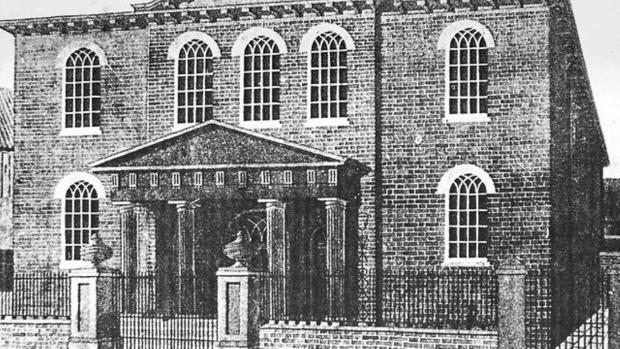
1819 Foundation stone of a Dissenting chapel laid in Princes Street, in the parishes of St Michael at Plea and St Peter Hungate. John Alexander is minister 1819-1866. “The Independents, who spring from the Brownists, assembled in Norwich before the year 1640, under the ministry of Mr Bridge, in a brewhouse, in St Edmund’s parish. In 1693 they completed the erection of the Old Meeting-house in Colegate, St Clements… 1819 chapel of white brick … “at the cost of £4,500, including £1,000 paid for the land. It will seat 1,000 hearers.” History, Gazetteer and Directory of Norfolk 1836
1819-1826 great building boom
1819 auction of Edward Squire’s estate

1820 George IV reign begins
1822/3 Elizabeth Aylmer dies, aged 76, in Aylsham. Bequeaths property to William Blake, of Swanton Abbott, included tenement and dwelling house with cellar and small piece of ground to the North, bounded by Mollett at St George Tombland to the East and Gibbs Leeds to the West. Possibly 2 Tombland Alley (is combined with deeds for 2 Tombland Alley in Norfolk Record Office)
Princes Street
1822 Pigot’s Directory
- John Baker, boot and shoe maker
- Thomas Buttifant cabinet maker
- Rainer Leech, joiner and builder
- Gibbs Leeds wire worker and sieve maker
- R Morgan, actuary
- Charles Mortar, rush, collar and mat maker
- R Skipper, Jolly Coopers
- John Ninham, painter, plumber, glazier
- Margaret Dawson Plumber’s Arms
Tombland
- Rising Mollett Iron monger
St Peter’s Hungate – permit office
Another Henry Ninham watercolour of Tombland Alley
1823 Barnett Crawcour starts appeal for funds to acquire land and build a synagogue.
1824 Susanna Bean purchases freehold of the tenement she was living in from William Blake. 2 Tombland Alley? Susanna married to Robert Murrell, licensee of Horse & Groom in St George Tombland, on the north side of Princes Street.
1827 – sale of a freehold dwelling house (26?), lately occupied by Mr Buttifant, and his under-tenants, with a stable and yard adjoining, situate in St George of Tombland, Norwich, fronting Prince’s Street and lying next the Church Alley. The situation of these premises is well adapted for a druggist’s or grocer’s shop, or any retail trade” Norfolk Chronicle.
1828 Synagogue opened at the back of 1 Tombland/2 Tombland and 26 Princes Street. A small, simple, brick built top lit room for a congregation of around 28 people.
1828 Repeal of Test and Corporation Acts in response to campaign by dissenters. Congregational Chapel built on the site of the dissenting chapel
1829 Rayner Leech, builder, bankrupt. Two of his properties on Princes Street up for auction. “Recently built” so may be present day 16 and 18 Princes Street.
1830 William IV reign begins
1830 Norwich population estimated at 61,000 (37,000 in 1800)
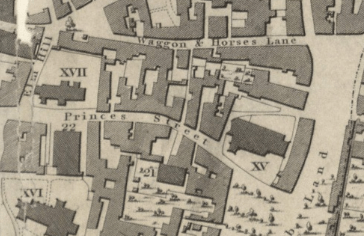
1830 Millard and Manning map
1830 Election candidates Richard Gurney (Whig) Robert Grant (Whig) Jonathan Peel (Tory), Sir Charles Ogle (Tory). Gurney and Grant elected. St George Tombland results: Gurney 30 Grant 29 Peel 32 Ogle 31:
Freemen
- Richard Brazell plaster (PO)
- Mark Brewer worsted weaver (PO)
- Charles Buckenham watch maker (PO) Tombland (1832 address)
- Thomas Buttifant, cabinet-maker (GG) Church yard
- James Calver brush maker (PO) Pigg lane
- Dennis Cocks blacksmith (PO) Waggon and Horses lane
- John Darken, builder (GG)
- Edmnd Kerrison clergyman (PO) Tombland
- Roger Kerrison solicitor (PO) Tombland
- Gibbs Leeds junior and senior, wireworkers (GG) Princes Street
- W.L. Lohr gent (PO) Samson and Hercules court
- Thomas Lovewell upholder (PO)
- John Maxey worsted weaver Gurney and Peel Elm lane
- Thomas Middleton blacksmith (PO)
- Henry Mitchell baker (PO) Palace Street
- Charles Mollett worsted weaver (GG) Tombland
- John Ninham, painter (GG) Princes Street
- Samuel Norris cabinet maker (GG) Waggon and Horses Lane
- William Rackham solicitor (PO) Princes Street Freeman and freeholder
- William Tooley Robberds gent (GG) Tombland
- James Russell grocer (PO) Palace Street
- James Watson gent (PO) Tombland
- Reuben Widdows, cordwainer (GG) Princes Street
- Henry Willett manufacturer (GG)
- freeholders – Edward Barron gent (GG), John Burton publican (GG), Henry Carter surgeon (PO), John Horne* cordwainer (PO), Anthony Hudson* esq (GG), Thomas Hudson* esq (GG), Benjamin Kitmer esq* (PO), John Mandall assistant surgeon (PO), John Nicholls* gent, (PO), William Fell Rand surgeon (PO), William Martin Seppings* merchant (PO), John Wollard publican (GG), Robert Woolterton surgeon (PO).
1830 Pigot’s Directory (Princes is Princess Street)
- James Aldis (brick layer, plasterer)
- John Baker (boot and shoe maker – St Peter Hungate voter)
- John Codling (academies, seminaries and public schools – St George Tombland voter)
- Walter B Hill 10 Princes Street (tailor)
- William Kitton (academies, seminaries and public schools St Peter Hungate voter)
- Gibbs Leeds (wire worker and sieve maker St George Tombland voter)
- William Samuel Ling (Tailor St George Tombland voter)
- Edward Medler (clothes salesman – St Michael at Plea voter)
- William Salter Millard (land agent)
- John Ninham (painter, glazier, plumber – St George Tombland voter)
- Francis Parkerson (bell hanger – St Michael at Plea voter)
- James Shickle (builder and carpenter St Peter Hungate voter)
- John Wilch (baker) at
- Mary Winn (milliner)
1830-1 Swing riots (agrarian riots) in Norfolk
1831 Benjamin Perowne’s Livery Stables on Princes Street
1831-2 economic depression across Britain, slack trade continued 1832-7
1832 Election – first after the Great Reform Act. Candidates: Lord Stormont and Sir James Scarlett (Tories), Richard Hanbury Gurney, the former member, and Mr. Charles Henry Bellenden Ker (Whigs). Scarlett and Stormont won.
Gross bribery prevailed, and a committee of investigation was at once appointed, meetings were held, and subscriptions were collected from house to house throughout the several parishes, in support of a petition to parliament against the return of the sitting members.
A riot followed. the “Purple and Orange” booth was pulled down, and a bonfire made of the débris. The “Blue and White” band, stationed near the fire, played their favourite tunes, and men carrying the banners of the party danced round the pile. Stones were thrown and bludgeons used, and a man had his arm broken. Many other persons sustained less serious injuries. The 7th Hussars, who had been removed from Norwich to Wymondham before the election commenced, were recalled to suppress the disturbance, and many citizens were sworn in as special constables. An officers’ guard of the Hussars was posted near the Guildhall throughout the night, and another polling-booth was erected. Voting recommenced at eight o’clock on the morning of the 11th, and continued all day; the books were again opened on the 13th, and at noon the poll finally closed, when the result was declared as follows:—Stormont, 2,016; Scarlett, 1,962; Gurney, 1,810; Ker, 1,766.
Freemen
- Thomas Buttifant – Churchyard, (GK)
- Robert Dann Princes Street (GK)
- Gibbs Leeds senior and junior Princes Street (GK)
- William Samuel Ling Princes Street (SS)
- John Ninham Princes Street (GK)
- William Rackham Princes Street (no vote)
- Reuben Widdows Princes Street (no vote)
Occupiers:
- John Codling Princes Street (GK)
- William Jary Cubitt Princes Street (SS)
Freeholders:
- William Rackham (Scarlett only)
- William Warren (Gurney only)
1834 Poor Law Amendment Act – established workhouses
1834 John Darken’s house on Princes St up for auction
1835 January – February – Election – candidates Viscount Stormont, Robert Scarlett (Tories), Edward Harbord, Frank Offley Martin (Liberals)
Freeholders
- William Rackham Prince’s Street (did not vote)
- William Warren Princes Street (did not vote)
- William Jary Cubitt, Princes Street
Freemen
- Thomas Buttifant – Church Yard (HM)
- John Darken Princes Street (HM)
- William Samuel Ling Princes Street (SS)
- John Ninham Princes Street (HM)
- William Rackham Princes Street (SS)
- Reuben Widdows Princes Street (HM)
Occupier
- William Jary Cubitt, Princes Street (SS)
1835 September – Municipal Reform Act removed privileged status of freemen in elections (non-resident freemen no longer had the vote, freemen by gift or marriage enrolled after 1831 also disqualified), introducing voting lists, polling booths and voting papers instead of verbal voting in public.
1836 civil registration of births, marriages and deaths made compulsory. Marriages conducted by non- Anglican clergymen made fully legal.
1836 White’s Directory
- James Aldis, plasterer and bricklayer, 10 Princes Street
- Robert Allgar, baker and flour dealer
- John Baker, 11 Princes Street, boot and shoe maker
- Chas & Geo Bindley, gas fitters
- Francis Bush, dyer
- William Jary Cubitt, St Paul’s plain, b. Princes Street, maltster
- John Darken joiners and builders
- Henry Greeves, tailor
- G. King, White Lion
- William Samuel Ling, robes (St George Tombland voter)
- Robert Mandall, joiners and builders
- Edward Medlar, clothes salesmen
- William Salter Millard, fire & life office
- Robert Moansear
- Henry Mounsear, Cooper’s Arms
- John Ninham, plumbers, glaziers and painters
- Rev John Owen
- Francis Parkerson, whitesmith
- Francis Parkinson, venetian blind manufacturer
- William Pedder, shopman
- William Rackham, attorney, Imperial fire and life office
- Rebecca Russell shopkeeper
- Reuben Widdows, Plumber’s Arms
- National School
- Kidd & Aldis, Stay makers
St George’s Church yard
- Sus. Murrell, shop keeper
- Thomas Buttifant, turner in wood
 Friends of Princes Street