
1600 – Richard Hall, cook, owns Princes Inn as of 1596. William Styward owns 22 Princes Street. Francis Clarke, clergyman owns 24-26 Princes Street as of 1581.
1603 reign of James I begins
1603-4 outbreak of plague in Norwich
1608 City Assembly ordered that three rooms at the New Hall (St Andrew’s Hall) be converted into a library, for the preachers in the city and as a lodgings chamber for preachers who come to the city to preach.
1610 William Styward/Steward dies
1614 Lawrence Wright of Norwich and Alice his wife, and William Pinchin of Norwich, barber, conveyed, on June 6th, 1614, to Richard Wright of Oxnead, yeoman, brother of Lawrence, a tenement in Tombland lately occupied by Wm. Pickering, barber, dec.,[see 1549] and now by the said Wm. Pinchin, which he had of Wm. Steward;, gent., deceased, son and heir of Augustine S., late citizen and alderman, deceased
1606 to 1626 Landgable Rental records Princes In as owned by Lady Barney/Berney, known as Dame Julian. Thomas Styward, son of William Styward, grandson of Augustine Steward/Styward had sold Gowthorpe Manor to Dame Julian in 1628. She was the widow of Sir Thomas Barney of Reedham, a sheriff of Norfolk, who had died in 1616.
1616 Francis Clarke, clergyman, dies in Riddlesworth, Norfolk. To Francis his son, tenement in St. Lawrence, Norwich, and property in Knettishall and Hopton; Mary, dau., two tenements in Tombland together; Elizabeth, dau., Gasthorpe property; Alice, dau.; Alice, wife, sole executrix. His daughter Mary Leggett inherits 24-26 Princes Street.
1620 Robert Halle, of Kiston, Hunts, cook, son and heir of Robert Halle of Norwich, on 19th June sold to Richard Harman of Norwich, skynner, a messuage whereof John Murrell of Norwich, taylor, and Edony his wife, late wife of Robert Brecles, tailor, dec., are seized, between Charles Powle, dec., W(est)., Clarke E(ast)., a tenement now of William Browne;, alderman, N(orth)., the highway S(outh). (probably 22 Princes Street)
1620 Richard Tooley, scrivener, is mayor of Norwich. Was said to have lived on Prince’s street, on the west side of Tombland Alley – probably lived on Tombland itself.
1624 Mary Leggett sells 24-26 to Thomas Harman, skinner, and his wife Anne. The two tenements are to the east of Richard Harman’s tenement, which used to belong to William Styward, then Robert Brecles, then John Clarke. To the east is the cemetery of St George Tombland and to the north is land formerly belonging to William Styward, then William Pyckering (barber) and now Richard Brice, with the highway to the south.
1625 outbreak of plague in Norwich
1625 Reign of Charles I begins
1625 Richard Tooley dies and is buried in St George Tombland. Son Robert to have properties that Richard lived in. John Tooley is supervisor of will.
1606-1626 landgable. Richard Harman and Anne Harman, widow, own tenements (probably 22-26) which used to belong to William Styward, adjoining the property which used to belong to the dean of Chappell of Field (Miles Spencer), with Princes Inn on the West and the Churchyard of St George Tombland on the east and the highway south.
1626 Richard Harman is sheriff of Norwich, living in 3 Princes Street, St Andrews
1627 Thomas Harman dies, skinner of the Close. Buried at St Mary in the Marsh. Wife Anne is left his messuage in Tombland and in St James.
1630 William Browne (mayor, lived in Samson & Hercules) and his wife Judith sell to John Spendlove clerk and Francis Heyward gent, a messuage between the house occupied by Robert Tooley late of Richard Tooley alderman and citizen, in part, and a common lane called Prince Lane in part, (to the) N(orth); the pike wall, next garden of Richard Brice and others, late of Lawrence Wright, Robert Breckles and others on S(outh).; house in tenure of said Robert Tooley, late of the said Richard Tooly in part, and high street of Tombland in part, E(ast).; and stable and wall of — Powell, widow, late Roger Gaywood, West.
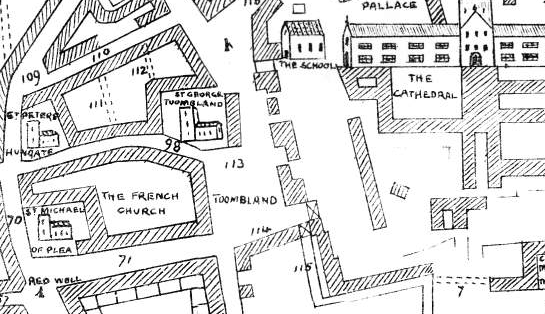
1630 Great Hospital map shows Mr Browne’s house as fronting Tombland, next to St George Tombland’s church (leftmost map, green coloured
https://www.thegreathospital.co.uk/resources/look.html)
1630 and 1631 outbreaks of plague in Norwich
1633 John Tooley is living in St George’s Tombland
1636 Richard Harman declines to take sides in the Norwich puritans’ petition to the King
1633 William Bridge was the lecturer of St. George Tombland, Norwich, up to the year 1637. “He was a pious and learned man, who held other livings and performed his duties well. To him, on a certain day, came Bishop Wren’s order to read the “Book of Sports” on the next Sunday in church. He sat in dejection, with the odious volume before him, abhorring the profaneness of its contents and its daring contradiction of Scripture. He resolved not to read it. He took counsel of his brethren, and several of them together refused compliance, fled to Yarmouth, and thence with sad hearts embarked for Holland, where they spent many anxious years, hoping to be allowed to return. Laud informed King Charles I that Bridge had left two livings and a lectureship and had fled to Holland; and the king wrote against his name this bitter sentence: “We are well rid of him.” It was an expression worthy of a bigoted and worldly mind. Thus it appears that the reformation was not the work of kings or bishops, or the great and learned. The history of those times is the history of persecuting power in opposition to the progress of the Gospel—an opposition the more dreadful inasmuch as it was carried on under the pretence of doing service to religion.” https://www.gutenberg.org/files/44568/44568-h/44568-h.htm
1638 Zelote, wife of Richard Harman dies, buried in St George Tombland
1638 John Tooley, merchant, is mayor, patron of St George Tombland
1639 Richard Harman, skinner, is mayor
1640 Richard Harman serves as MP in the Long Parliament until his death
1642 William Bridge returns from exile in the Netherlands to Norwich
1643 Richard Harman refuses to contribute to a voluntary collection for the parliamentary army
1644 John Tooley mayor again
1645 letter from Richard Harman to John Tooley (Puritan and mayor) making payment of £187 noting that “the citty of Norwich is yet in the sequestration business”
1646 Richard Harman dies – buried at St Andrews. His sister in law Anne nee Gray also dies.
1646 St George Tombland united with St Simon and St Jude by the Westminster Assembly of Divines, as part of a move to set up presbyteries in Norwich
1647 Thomas and Anne Harman’s second daughter Anne and her husband John Linsey, a worsted weaver, sell part of their messuage in Tombland to John Tooley and Thomas Balliston who then sell in on as the mediety (middle part) of a messuage in Tombland to Andrew Boardman, skinner, married to Grace, the older daughter of Thomas and Anne Harman
1648 Norwich riots – John Tooley is a supporter of Norwich mayor John Utting, accused of allowing the appointment of a Royalist. John Tooley is fined £1000 and disabled from holding any office and committed to Fleet Prison for 3 (6?) months.
1649 Charles I executed
1653 Cromwell Lord Protector
1653 John Tooley dies – “the last of the Tolyes” – buried at St Michael at Plea
1654 Andrew Boardman dies, leaving his wife Grace as executrix of his will and inheritor of his St George Tombland property. Grace then marries a widower, woolcomber Francis Aylmer, who has a son Philip.
1654 James Scarfe of Norwich, baker, and Mary his wife, late daughter of Richard Harman of Norwich, skynner, dec., on 24th May, 1654, granted to Thomas Baleston and Thomas Turner of Norwich, gentlemen, a messuage late of Richard Harman, before of Robert Hall, and previously of Roger Hall, between property of Charles Powell W(est)., — Clarke E(ast)., William Browne;, Esq., dec., N(orth).; common street S(outh).
1657 Christopher Jay, draper, mayor. Rebuilt the house now known as Samson and Hercules. Royalist. Married to Judith Browne, daughter of William Browne, former Mayor, who lived at Samson and Hercules in 1630.
1658 Richard Cromwell Lord Protector
1659 poor rate payers include Christopher Jay
1660 Restoration, Charles II
1660 St Simon and St Jude parish becomes independent of St George Tombland again.
1661 Christopher Jay – burgess in parliament until his death in 1677. Buried at St George Tombland.
1661 Francis and Grace Aylmer transferred ownership of the messuage in Tombland (20 or 22 to 26) where they were living to Richard Lynsey/Linsey, another woolcomber, who was married to Rebecca, the daughter of Andrew Boardman and Grace. This messuage was situated between the churchyard on the east, a messuage owned by Thomas Fairecloth and Prince’s Inn to the west, the king’s highway [Princes Street] to the south and the garden late of Edmund Brice, deceased, to the north. This was done as a quit claim, in default of the £100 not paid as per legacy of Andrew Boardman. Two days after, Richard and Rebecca sold the messuage back to Francis and Grace.
1662 to 1670s poor rate payers include Christopher Jay, Augustine Skottowe, John Becroft, Francis Aylmer
1665. Robert Scarfe, woolcomber, and Lydia his wife, on 20th Dec., 1665, sold to William Tuke; of Norwich, worsted weaver, tenement sometime of Robert Hall, afterward of Richard Harman, late of James Scarfe and Mary Scarfe (nee Harman), between messuages of Charles Cowell W., – Clarke E., William Brown, Esq., dec. N., King’s highway S.
1665. William Tuke;, worsted weaver, and Elizabeth his wife, on 23rd Dec., 1665, sold to William Mendham of Norwich, bodismaker, a messuage sometime of Robert Hall, late bought of Robert Scarfe, and now occupied by Thomas Lacey
1666 Plague comes to Norwich. St George Tombland one of the least badly hit – probably due to being more prosperous, residents could move to second homes in the countryside.
1668 William Mendham of Norwich, bodismaker, and Olive his wife, on 19th Dec., 1668, sold to Joseph Larwood;, cordwainer, and Martha his wife, a tenement sometime of Robert Hall, late bought of William Tuke.
1672 Grace Aylmer dies at age of 59
1672 John Dawson; of Framlingham, Suffolk, Gent., and Sarah his wife, only daughter of John Gostlin of Bawburgh, Gent., dec., and Thomas Mudyclift of New Buckenham, Gent., and Mary his wife, relict of said John Gostlin, on 22nd Mar., 1672,released to William Burgesse of Norwich, carpenter, a messuage called “Prince’s Inne,” now occupied by John Becroft and Joel Sargesson (son of Thomas Sargesson, who had been an apprentice to Roger Hall, cook, Princes Inn), or their undertenants, situate between a messuage sometime of Thomas Spendlove, Gent., and late of Roger Smith, Gent. W., a messuage now or late of Christopher Jay, Esq., in part, and a tenement now or late of Jacob Larwood; in part E., king’s highway S., lane called Prince’s Inn Lane N.
1685 James II
1686 Will of William Burgesse dated 31 October, 1686, he gives his wife Ann his tenements in Tombland, lately purchased of John Dawson; and Mary his wife, and of Tho. Muddicliffe and Mary his wife, occupied by Ralph Nicholas, Peter Delahay, clerk, Willm. Lintell, Wm. Clark, and Saml Partland;, for her life; and, after her death, to Peter Burgess, clerk, his kinsman.)
1686 Francis Aylmer dies at age of 58. Son Philip (1648-1727) inherits properties. Buried at St George Tombland – memorial to Francis and Philip in church.
1689 Mary II and William III
1689 William Burgess dies. Buried at St John Maddermarket. Wife Ann(e) inherits estate east of Princes Inn.
1689 Act of Toleration legalising various Protestant congregations
1693 Meeting House built on Colegate by the Independents, former Puritans. A chapel of white brick … “at the cost of £4,500, including £1,000 paid for the land. It will seat 1,000 hearers.” History, Gazetteer and Directory of Norfolk 1836
1696 Clere map
 Friends of Princes Street