1508 (not 1507 as Blomefield claimed) at least two fires broke out, the second one devastating St George Tombland and other parishes.
It seems many wealthy Norfolk gentry took the opportunity to acquire land and ruins in the city centre, and preferred to keep them as orchards and gardens rather than rebuild. Alderman Augustine Steward (1491-1571, usually known at the time as Austen Styward) was one of them, acquiring Princes Inn estate at the same time as acquiring the Pastons’ residence on Elm Hill. Steward was a mercer – a merchant who dealt in fine cloth, including silk.
1509 Henry VIII reign begins
1524 Norwich ranked as most prosperous medieval city in England.
1524 Dispute between city and cathedral priory finally resolved by Cardinal Wolsey. The priory’s Pentecost fair held in Tombland was surrendered to the King and granted to the city. In return, the Cathedral was put outside the City’s jurisdiction.
1534-5 Augustine Steward (aka Austen Styward, 1491-1571) is mayor for the first time, starts negotiating with the King to revisit the 1524 settlement.
1536 Dissolution of the monasteries begins.
1538 Augustine Steward asks for reduction of rent on Princes Inn estate because it is a void messuage.
1538 existing parish records for St George Tombland start
1539 Letters of patent granted in the city’s favour in the dispute with the Cathedral.
1540 Augustine Steward buys Blackfriars monastery for the city
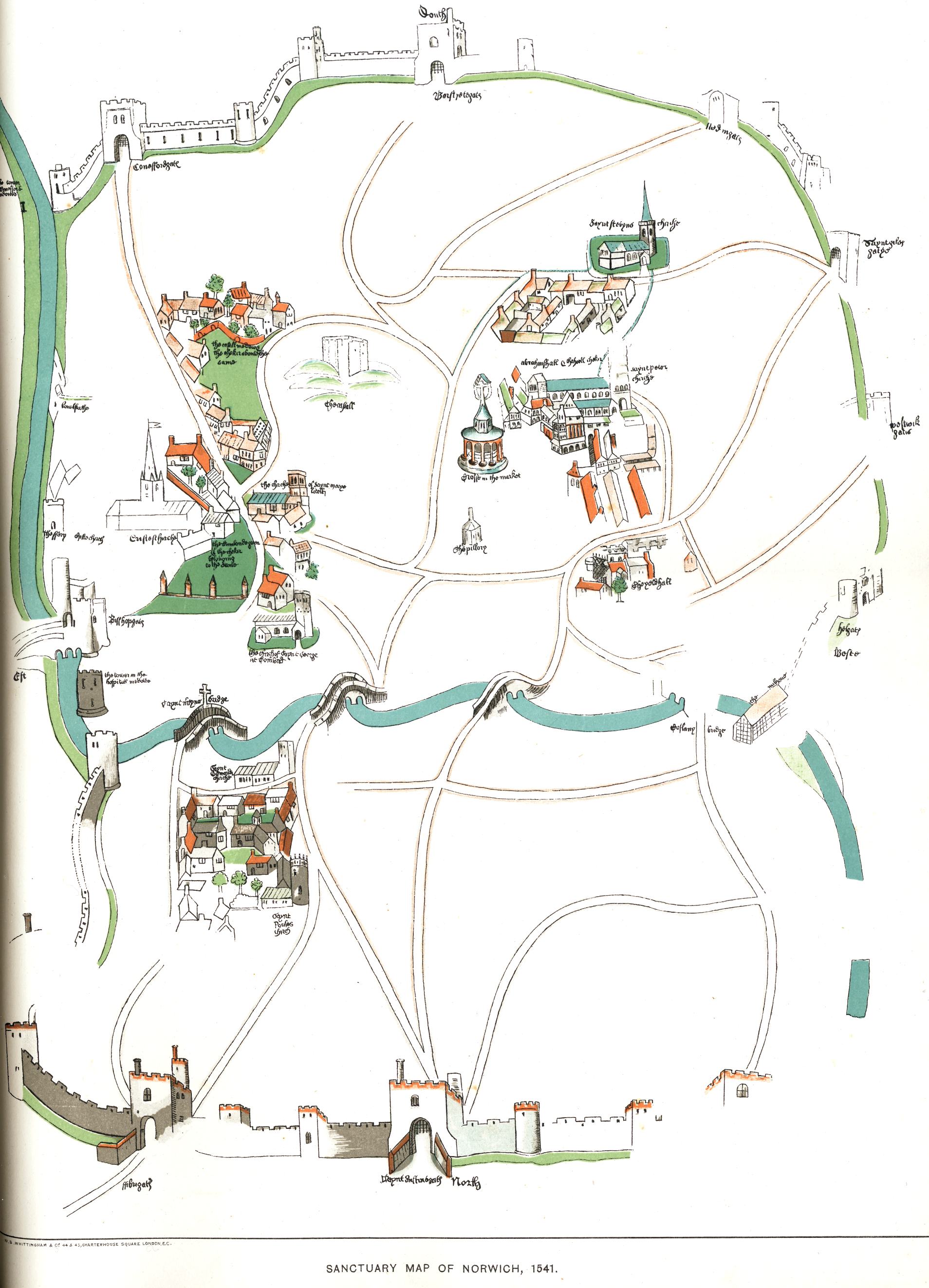
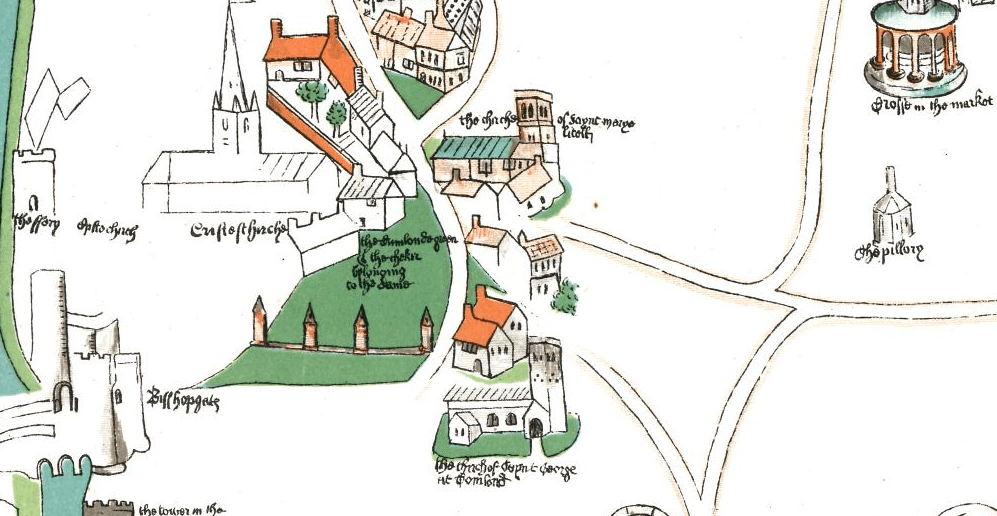
1541 Sanctuary map shown above. Made to show metes, bounds, and areas of sanctuary within the city; ordered by commission from the king to the mayor of Norwich dated 10 February, 3[2] Henry VIII , following Act of 1541 to restrict rights of sanctuary. Indicates St George Tombland and neighbouring buildings are sanctuaries.
1541-1547 Princes Inn continues to be referred to as a void messuage
1542 St Mary the Less, the French church, was consolidated into St George Tombland
1545 the chapel and college of St Mary in the Fields were surrendered to the crown and the chapel and cloister destroyed. The remaining buildings were granted Dr Miles Spencer, who used the college as his private residence. The rest of the property included three messuages at St George’s and their gardens and orchards. (Blomefield). This may have been Princes Inn, 22-26 Princes Street/Tombland Alley and what became Augustine Steward’s House and the Samson & Hercules, which Spencer leased or sold off.
1546 Augustine Steward is mayor for the second time
1547 Edward VI reign begins
1549 Book of Common Prayer
1549 Kett’s Rebellion. Augustine Steward’s house on Tombland ransacked by rebels. Steward was deputy mayor.
1550 the ‘Great Rebuilding’ begins
1553 Mary I reign begins
1554 injunction for deprivation of all English clergymen who had taken wives.
1555 Heresy statute goes into effect
1556 Augustine Steward is mayor for the third time
1557 First of Norwich’s two convicted heretics is burnt
1558 Elizabeth I reign begins
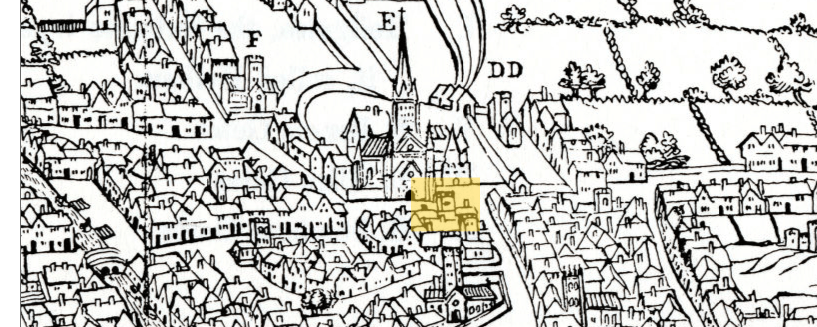
Above: Cunningham map of 1558. St George Tombland highlighted
1558 Act of Uniformity – requiring church going
1558 Richard Tooley senior and junior buy a tenement occupied by Edward Wright, cutler, between St George Tombland and Tombland from John Pye (site where Edith Cavell etc now are)and his wife Anne, formerly Linacre nee Pye, which Sibyl Pye, widow of John Pye senior, had given to John and Anne in her will.
1558-9 influenza epidemic
Before 1565 Miles Spencer sells two tenements (see below) to John Clarke/Clerke, a cook, and his wife Elizabeth, nee Clarke
1565 – John and Elizabeth Clerke grant to Augustine Styward a tenement and garden (which the said John and Elizabeth Clerke bought of Miles Spencer; LL.D.) between a tenement of the said John Clerk E(ast)., a tenement of the said Augustine Styward W(est), a garden of the said Augustine Styward N(orth), and a highway S(outh). Possibly = sale of 22 to Styward and continuing to live in 24 and 26 Princes Street
1565 Queen Elizabeth I issues letter of invitation to 30 Dutchmen
1568 return of aliens shows 1,132 Dutch speakers, 339 French speakers. Largest number of immigrants were in West and Mid Wymer. St George Tombland is in East Wymer.
1568-1570 landgable records show Augustine Steward has passed on Princes Inn messuage to son William (1527/30 – 1610) – clergyman and alderman. Neighbouring tenement (22?) owned by Augustine Sotherton (bef 1553-1585), grandson of Augustine Steward.
1570-1579 Poor rate payers in St George Tombland include the Tooleys, William Pickering
1578 Queen Elizabeth I visits Norwich
1579 Plague comes to Norwich. No records for burials in St George Tombland for 20 months to March 1581
1582 Francis Clarke of Gasthorpe, a clergyman, purchases two messuages (24-26?) in St George Tombland from his sister Elizabeth Clarke – widow of John Cle/arke, now married to Edmund Bradye, an innhoulder. Properties are between William Styward/Steward to the west, cemetery of St George Tombland to the east, and the garden of William Styward to the north, with the highway (Princes Street) to the south. In the tenure of William Pyckering (?-1598), a barber.
1583 outbreak of plague in Norwich
1588 Richard Tooley, scrivener, buried in St George Tombland. Half of messuage and garden in St George Tombland and in Cathedral precinct to his wife Johanna. The other half to his son Richard and grandson Robert.
1590 outbreak of plague in Norwich
1595 muster roll includes Richard Tooley and his 3 servants, Thomas Harmand and Richard Harman his servant, Roger Halle, cook and his servant.
1596 Norwich Assembly – recorded that Richard Hall, cook, was to have “a certain late waste ground, now re-edified, called Prynce Inn” which had been purchased by the City of Norwich
1570-1730 population of Norwich trebles from 10,000 to 30,000
Sources:
The Mayors of Norwich 1403 – 1835- Cozens Hardy and Kent
A History of Norwich – Frank Meeres
A History of 20 Princes Street – Geoffrey Kelly
The Visitation of Norfolk 1563
A Topographical History of Norfolk – Francis Blomefield, volume 3
Depositions Taken Before the Mayor & Aldermen of Norwich, 1549-1567 https://archive.org/stream/depositionstake00socigoog/depositionstake00socigoog_djvu.txt
Edith Cavell site https://www.achurchnearyou.com/church/6821/page/22600/view/
 Friends of Princes Street